
Alchemised’s magic system runs on resonance, a measurable energy present in people and matter. Alchemists channel resonance into four disciplines inorganic alchemy (metal), vivimancy (the living), necromancy (the dead), and animancy (the mind). Everything past basic metalwork draws on the practitioner’s own vitality, a cost known as the Toll.
Spoiler level: the sections below are written to be spoiler-light they explain mechanics, not plot. A handful of sections are clearly marked where a mechanic’s use in the story is relevant to understanding it.
Alchemised Magic System Explained Without Spoilers
Alchemised’s magic runs on resonance, a natural energy present in people, metals, and matter that some individuals are born able to sense and shape. Having resonance isn’t the same as having power over everything what an alchemist can actually do depends on repertoire, an inherent affinity for specific materials or effects that can’t be freely swapped between disciplines.
Alchemy branches into four areas: inorganic alchemy reshapes metal and inert matter, vivimancy heals living tissue, necromancy reanimates the dead, and animancy the rarest and most feared branch affects memory and the mind. None of it is free. Anything beyond basic metalwork draws on the practitioner’s own vitality, a cost called the Toll, and larger or sustained effects require stabilizing structures called arrays. Lumithium, the material tied to resonance’s existence, is as dangerous as it is essential.
This summary avoids plot details entirely. Everything below expands on these same mechanics; sections that touch on how they play out in the story are labeled.
Sources & verification: This guide is built from the novel’s text where it was directly available (including its opening chapter) and cross-referenced against several independent fan-written guides, glossaries, and reviews. Confidence isn’t uniform across every claim. Core mechanics resonance, repertoire, the four disciplines, the Toll, and lumithium’s dual danger are corroborated across multiple independent sources and treated as reliable. A smaller number of details, including the term “lich” and the specifics of how the Undying achieve their transformation, trace to a single fan-compiled source and are labeled as such rather than presented as confirmed. Nothing here is attributed to an author interview, quote, or page citation that wasn’t actually sourced.
What Is the Magic System in Alchemised?
At its core, the Alchemised magic system is built on resonance a natural energy that exists within people, metals, and other matter, and which some individuals are born able to sense and manipulate. Resonance isn’t a spell system or a pool of “mana.” It behaves more like a physical property: measurable, unevenly distributed, and governed by material rules rather than willpower alone.
Alchemy is what alchemists do with that resonance the practical manipulation of matter, life, and in rarer cases, the mind. An alchemist is simply a person with resonance who has trained to direct it toward a specific purpose. Possessing resonance is not the same as having power over everything; what any individual alchemist can actually affect is shaped by a narrower trait called repertoire, covered in detail below.
Resonance behaves differently depending on what it’s connected to. In a person, it’s tied to vitality and can be drawn on, expended, or shared. In metal and other inorganic material, it acts more like a responsive property that can be reshaped through transmutation. Same energy, different behavior depending on the target which is why healing and metalworking look nothing alike even though both run on resonance.
It’s also worth being clear about what resonance isn’t. It doesn’t function like a “mana bar” that refills on its own most fantasy magic systems treat power as a generic resource you spend and regenerate. Resonance is closer to a physical trait: some people have more of it than others, it’s tied to specific matter and specific bodies, and using it for anything beyond metalwork draws directly on the user’s own vitality rather than a separate magical reserve.
Magic manifests across four broad categories, which the rest of this guide walks through individually: inorganic alchemy (metal and matter), vivimancy (the living body), necromancy (the dead), and animancy (the mind). Readers who want a map of who actually wields these abilities in the story can check our guide to the Alchemised characters alongside this breakdown of how the system works.
What Is Resonance in Alchemised?
What does resonance mean?
Resonance is the foundational energy of the Alchemised magic system. It exists in people, in metals, and in matter generally, and it’s what alchemists sense and direct when they perform any form of alchemy. It is not inherently good, evil, or mystical it functions closer to a natural force than a moral one.
Who can use resonance?
Not everyone has resonance, and among those who do, the amount varies. Resonance is unevenly distributed across the population, and it tends to concentrate in regions rich in lumithium deposits the material most closely tied to its existence. In Paladia, this geographic link means resonance is far more common than in most other regions, which in turn shapes labor, migration, and class structure around lumithium-producing areas.
How does resonance relate to alchemy?
Resonance is the raw energy; alchemy is what a trained individual does with it. Having resonance gives someone the potential to practice alchemy, but resonance on its own doesn’t produce any specific effect. It has to be shaped through training and channeled toward a particular application metal, flesh, or mind.
What determines an alchemist’s abilities?
Two things: how much resonance a person has, and what their repertoire allows that resonance to meaningfully affect. Resonance quantity determines raw capacity; repertoire determines direction. A powerful alchemist with a narrow repertoire will still be locked out of disciplines their resonance doesn’t naturally respond to.
Can every alchemist manipulate the same materials?
No. This is one of the more counterintuitive parts of the system for new readers: resonance is not interchangeable between alchemists. Someone whose resonance aligns with metal can’t simply decide to become a healer, and a healer can’t retrain into industrial metalwork, regardless of how much resonance either of them has. That limitation comes down to repertoire, which behaves less like a skill and more like an inherent trait.
How resonance connects to the rest of the system
- Resonance → alchemy: resonance is the raw energy; alchemy is the trained practice of directing it.
- Resonance → repertoire: repertoire determines what a person’s resonance can meaningfully affect, not how much of it they have.
- Resonance → vitality: in living bodies, resonance is tied to vitality and gets spent when organic alchemy is used.
- Lumithium → resonance: lumithium is the material that generates and concentrates resonance in the first place.
How Does Alchemy Work in Alchemised?
Metal and inorganic alchemy
The most publicly accepted and socially “respectable” form of alchemy is inorganic alchemy sometimes called transmutation or alchemisation which applies resonance to metals and other non-living materials. This covers reshaping metal, creating alloys, and powering the industrial and architectural backbone of Paladia. Because it doesn’t draw directly on a living body’s vitality, inorganic alchemy is comparatively sustainable and forms the economic foundation of the guild system.
Transmutation
Transmutation is the general term for using resonance to alter the structural properties of matter — most commonly metal, though the underlying principle (reshaping something at a fundamental level through resonance) also underlies more dangerous applications elsewhere in the system, including memory alteration in animancy. Alchemists consider transforming one metal into another among the most technically demanding forms of alchemy.
What Is Lumithium in Alchemised?
Lumithium is the material that generates resonance. It’s described as binding the classical elements together, and that binding is what produces resonance in the first place which is why lumithium-rich regions produce disproportionately more resonant people, and why exposure can make otherwise inert materials alchemically responsive.
Lumithium is also dangerous on both sides of that divide. For people without resonance, sustained exposure causes a wasting sickness. For people with resonance, direct contact triggers sharp, nerve-level pain, as though the body is being overwhelmed by energy it already carries. That double edge shapes labor in Paladia: lumithium has to be mined by non-resonant workers, but their children are frequently born resonant and unable to continue that work, driving constant population movement around mining regions.
What determines an alchemist’s specialty?
Specialty comes down to repertoire the specific range of materials and transformations a person’s resonance naturally responds to. Professional labels like metallurgist, pyromancer, or healer aren’t separate magic systems; they’re roles built around where an individual’s repertoire happens to align.
What Are Arrays, Binding, and Nullification in Alchemised?
Arrays are symbolic diagrams or patterned constructions that give resonance direction and stability for effects too large or too sustained to hold through raw resonance alone. They function like engineering schematics rather than decoration long-term seals, Transference, and sustained immortality are all described as depending on them.
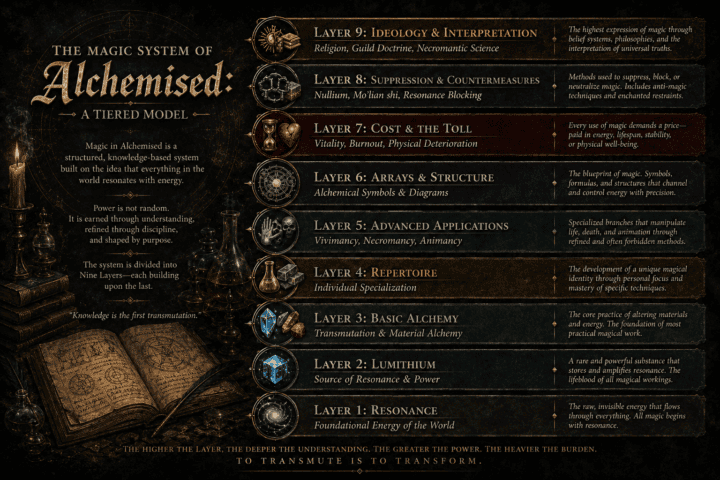
Binding and nullification are related but distinct countermeasures, not two names for the same thing. Binding locks down a person’s identity or powers directly. Nullification works on resonance itself, suppressing or blocking it usually through a physical material rather than through training or willpower. Both show up in restraints and weapons throughout the story, which is the clearest evidence that resonance obeys physical rules and can be contained by the right method.
The limitations and costs of alchemy
Alchemy is not free. Inorganic alchemy is the least costly form, since it doesn’t draw directly on the practitioner’s own life force. Once alchemy moves into living tissue, however, it starts drawing on vitality a finite resource and the cost escalates the closer the discipline gets to the body and mind. This cost structure is explained fully in the section on the Toll below.
Related Post: Alchemised Themes Explained: Memory, Power, Trauma & Identity
The Different Types of Magic in Alchemised
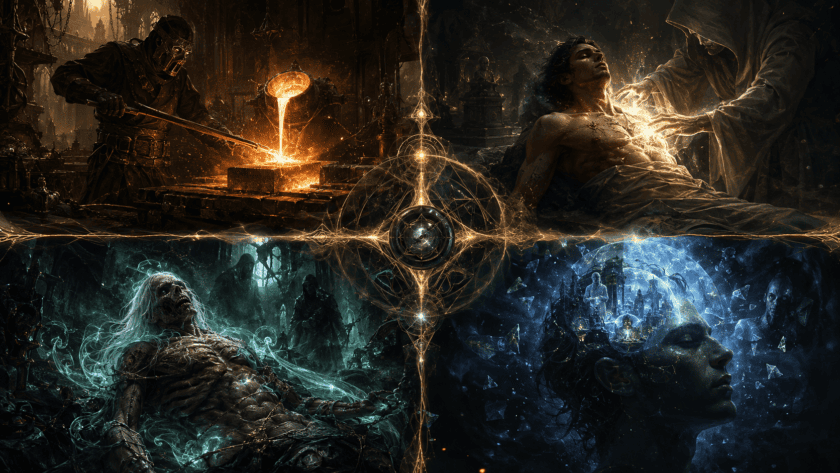
Resonance expresses itself through four major disciplines, distinguished by what they act on rather than by separate sets of rules. Moving from metal, to flesh, to death, to mind, each discipline becomes rarer, more costly, and more tightly controlled.
| Discipline | What it affects | Main applications | Limitations / cost | Social status |
|---|---|---|---|---|
| Inorganic alchemy | Metal and inert matter | Transmutation, industry, construction, weaponry | Low — doesn’t draw directly on vitality | Publicly accepted; economic backbone of the guilds |
| Vivimancy | Living tissue and life force | Healing, restoring vitality; can also drain or harm | The Toll — redistributes life, doesn’t create it | Tolerated as “clean” alchemy |
| Necromancy | Dead organic matter | Necrothralls, sustaining the Undying | Requires constant maintenance; no true resurrection | Forbidden and taboo |
| Animancy | Mind, memory, and identity | Reading, altering, or transferring consciousness | Damage is often invisible until catastrophic | Feared and suppressed as a dark art |
What Is Vivimancy in Alchemised?
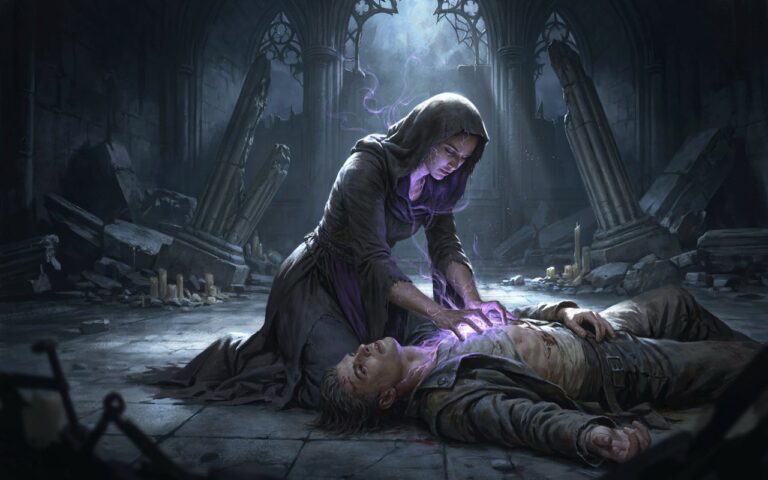
Vivimancy is the alchemical discipline that applies resonance to living tissue. A vivimancer reads the resonance of a body, identifies where it has been disrupted by injury or illness, and redirects resonance to accelerate the body’s own recovery.
What can vivimancy do?
At a functional level, vivimancy allows a trained practitioner to heal wounds, stabilize failing bodies, and restore vitality to someone who is weakened. It works less like a flashy spell and more like an accelerated, intuitive form of medicine.
Vivimancy and healing
Healing is vivimancy’s most accepted use. Most trained healers practice it for years without serious consequence, because moderate healing draws on the body’s own recovery processes rather than replacing them outright.
Can vivimancy harm people?
Yes. The same manipulation of living resonance that heals can also drain life force or inflict harm. Healing and harm come from the same technique aimed in different directions, which is part of why vivimancy is viewed with unease even where it’s officially tolerated.
Vivimancy and the Toll
Vivimancy has a firm limit: it redistributes life, it doesn’t create it. Healing an injury that should be fatal — or attempting anything close to reanimation requires spending vitality, either the healer’s own or vitality drawn from an external source. This cost is referred to as the Toll, and the more severe the injury, the higher the price. Repeated high-level use leads to exhaustion, physical degradation, and eventually irreversible harm to the healer.
Why is vivimancy controversial?
Because the line between healing and harm is a matter of degree, not kind. The same techniques that mend a body can also prolong suffering, reshape it against its will, or edge into necromantic territory if pushed past death. Paladia’s religious authorities tolerate healing specifically because of its cost and its life-preserving purpose, while treating other applications of vivimancy with far more suspicion.
What Is Necromancy in Alchemised?
Necromancy applies the same underlying resonance principles as vivimancy, but to dead organic matter instead of living tissue. Where vivimancy works with life, necromancy works past it.
How necromancy differs from vivimancy
Vivimancy redistributes a living body’s own vitality to heal it. Necromancy uses external resonance and sustained maintenance to animate matter that no longer has life of its own. The result isn’t restored life — it’s movement and obedience imposed from outside.
What are necrothralls?
Necrothralls are reanimated corpses controlled entirely by an outside necromancer. They retain no memory, identity, or will of their own; they move and respond only according to the commands and resonance sustaining them. In Paladia, necrothralls are used for labor, punishment, and battlefield reinforcement treated as disposable resources rather than people, and requiring continual upkeep to keep functioning.
What are liches?
One fan-written guide describes a “lich” as a necromancer whose own consciousness has been transferred into a dead body distinct from a necrothrall because a lich retains intellect and intent even as the body decays. This distinction comes from a single source rather than something confirmed across multiple independent references, so treat “lich” as a useful conceptual label for now rather than a term firmly established in the book’s own vocabulary.
What are the Undying?
The Undying are the immortal ruling regime that takes power after Paladia’s war, led by the High Necromancer. Rather than animating a decaying corpse, the Undying are described as engineering a stable, non-decaying body through advanced necromantic alchemy reportedly involving a lumithium-coated talisman used in the transformation. Unlike a necrothrall or a lich, an Undying individual isn’t reanimated from death; they deliberately transform themselves to circumvent it.
Why is necromancy forbidden?
Necromancy is treated as taboo by Paladia’s pre-war religious order because it violates the boundary between life and death that vivimancy is only barely permitted to approach. It’s also politically dangerous: a necromancer with enough skill can raise an army, which is precisely how the Undying regime consolidates power over the course of the story.
How does necromancy relate to vivimancy?
Necromancy and vivimancy draw on the same underlying resonance mechanics reading and redirecting the energy tied to a body. The dividing line is life itself: vivimancy operates on bodies that are still alive, and stepping past that line, into bodies that no longer are, is what turns healing into necromancy.
What Is Animancy in Alchemised?
Animancy is the rarest and most feared discipline in the Alchemised magic system because it targets the mind rather than the body.
What does animancy control?
Animancy governs memory, thought, emotion, and consciousness itself. A trained animancer can read a mind’s resonance, alter or erase memories, implant thoughts, and influence emotional states.
Animancy vs vivimancy
Vivimancy works on the body tissue, injury, vitality. Animancy works on the mind — memory, identity, awareness. Where vivimancy’s damage is visible (wounds, exhaustion, physical decline), animancy’s damage is often invisible until it’s already catastrophic, because it affects the self rather than the flesh.
Memory manipulation
Reading, suppressing, or altering memory is one of animancy’s defining and most dangerous applications. Because memory underlies identity, tampering with it isn’t a minor act — it can reshape who a person understands themselves to be.
Consciousness and identity
Animancy’s reach into consciousness is what makes it politically explosive in Paladia. A skilled animancer can influence not just what someone remembers, but how they perceive and interpret themselves and their surroundings.
Animancy is also where Transference sits an ability significant enough to cover in its own section below.
Why is animancy so rare and dangerous?
Animancy is rare because very few alchemists’ resonance aligns with the mind at all, and it’s dangerous because the consequences of failure are often irreversible and hard to detect. Paladia’s Order of the Eternal Flame treats it as a dark art and suppresses its practitioners, which is a major reason why animancers in the story tend to conceal what they can do.
Related Post: Alchemised by SenLinYu Summary: Ending Explained, Characters, Magic System & Themes
Animancy vs Vivimancy vs Necromancy
These three disciplines share the same underlying resonance mechanics, applied to three different targets. The table above already covers what each affects and costs; this one focuses on how they relate to each other.
| Comparison point | Vivimancy | Necromancy | Animancy |
|---|---|---|---|
| Relationship to life/death/mind | Works with the living | Works past death | Works within the self |
| Where damage shows up | Physically wounds, exhaustion, decline | Physically decay, degradation | Often invisible until it’s already severe |
| Boundary crossed if misused | Healing tips into harm or reanimation | Reanimation without consent or limit | Memory or identity altered without consent |
What Is Transference in Alchemised?
Transference is an animancy-linked ability that moves a mind or consciousness described in one glossary as a soul into another body or mind. It sits under animancy because both act on the same target: the self, not the body.
What’s well-supported: Transference is used as an invasive interrogation method, forcing one mind into another until the target’s secrets surface. Like other organic alchemy, it draws on vitality and carries a real physical cost to whoever performs it.
What’s less certain: at least one reviewer describes an intimate, consensual form of “resonance transference” between two characters who trust each other. It’s not clear from available sourcing whether this is the same named mechanic used coercively elsewhere, or a reviewer’s own descriptive language for a closely related but distinct moment of shared resonance. Treat the coercive use as the confirmed mechanic and the intimate framing as an interpretation worth double-checking against the text.
Spoiler note: Transference plays a meaningful role in how the plot resolves for at least one major character. This guide doesn’t detail that use it’s flagged here so readers who want to stay unspoiled know the term reappears at a plot-significant moment later in the book.
Transference → animancy: Transference is presented as an application of animancy, not a separate discipline the ability to move a mind or consciousness follows the same rules (and the same suppression via nullification and binding) as the rest of the discipline.
What Are Metals and Repertoire in Alchemised?
Why metals matter
Metal is where inorganic alchemy lives, and it’s also where Paladia’s social hierarchy is most visibly written into the magic system. Silver is treated by religious doctrine as a noble metal, associated with spiritual purity and higher status. Iron is coded as a base, industrial metal tied to labor rather than divinity — even though iron-aligned alchemy, as practiced by the Ferron family, is capable of reshaping entire cities through industry and infrastructure. Symbolic status and practical power don’t line up.
What Is Repertoire in Alchemised?
Repertoire is the specific set of materials, transformations, and interactions an individual’s resonance responds to most naturally. It’s treated as an inherent trait closer to a physical characteristic than a learned skill though training can refine how effectively someone works within it.
Can an alchemist use every type of alchemy?
No. Repertoire acts as a hard limit. An alchemist whose resonance aligns with metal cannot perform vivimancy at a meaningful level no matter how much they train, and the reverse is equally true. Two alchemists with identical amounts of resonance can still be completely incapable of doing each other’s work, because quantity of resonance and repertoire are separate traits.
This is also why professions in Paladia read as identity rather than career choice. A metallurgist, a healer, and a mind-worker aren’t three people who picked different jobs they’re shaped by what their resonance was always going to respond to.
The Cost and Limitations of Alchemised’s Magic System
- The Toll: Healing injuries that should be fatal, or performing other high-level organic alchemy, requires vitality — a finite resource drawn from the practitioner or an external source. Bigger injuries mean a bigger cost, and repeated heavy use leads to burnout, chronic physical deterioration, and eventually collapse if a practitioner ignores their limits.
- Limits of healing: Vivimancy cannot create life from nothing. It moves and spends vitality; it doesn’t generate it.
- Risks of animancy: Because animancy affects the mind, damage from its misuse is frequently invisible until it becomes severe or permanent.
- Limits of necromancy: Necrothralls sometimes referred to in source material simply as “Thralls” require constant maintenance and degrade over time. Immortality through necromancy is achieved by engineering around the body’s natural limits, not by escaping cost altogether.
- Lumithium exposure: Non-resonant individuals exposed to lumithium over time develop a wasting sickness; resonant individuals experience sharp nerve pain on direct contact.
- Nullification and binding: Resonance can be physically blocked (nullification) or a person’s powers and identity locked down (binding). Suppression materials built into restraints and weapons show that magic in this world obeys physical rules rather than existing beyond them.
Every discipline here is checked by cost, material limitation, or social control usually more than one at once.
How the Magic System Shapes Paladia
Magic and social hierarchy
Because resonance concentrates around lumithium deposits, geography directly shapes who has access to power and who ends up doing the dangerous labor of mining it. Metal type compounds this into a class structure: silver-aligned families carry religious prestige, while iron-aligned families like the Ferrons build wealth and industrial influence despite occupying a lower symbolic rank. Class in Paladia isn’t just wealth it’s which metal, and which discipline, your resonance happens to answer to.
Magic and religion
Paladia’s pre-war religious authority — referred to across sources as either the Order of the Eternal Flame or the Sacred Faith, likely the same institution under different informal names — regulates which forms of alchemy are acceptable. Vivimancy is tolerated because of its healing purpose and its real cost; necromancy is forbidden as a violation of the line between life and death; animancy is suppressed as a dangerous “dark art” because of what it can do to the mind.
Magic and warfare
Necromancy and inorganic alchemy both have direct military applications — necrothralls as expendable soldiers and laborers, and metal alchemy powering weapons and infrastructure. The war that reshapes Paladia is fought and ultimately decided through both.
Magic and political control
Suppression materials and the ability to physically block resonance turn magic into a tool of political control as much as personal power. Whoever controls access to resonance through restraint, regulation, or outright suppression controls who is allowed to be dangerous.
Why alchemy matters to Paladia
Alchemy in Paladia isn’t a background detail; it’s the basis of the economy, the class structure, the religion, and the military. Understanding resonance, repertoire, and the Toll is understanding how Paladia’s entire society is organized which is also why the characters wielding these abilities carry so much political weight. For a closer look at who holds which of these abilities, see our Alchemised character guide.
The spoiler-free summary near the top of this guide covers the same ground in more compact form, if you want a refresher before the FAQ below.
Alchemised Magic System FAQ
What is the magic system in Alchemised?
It’s a resonance-based system in which alchemists manipulate a natural energy present in people and matter. Alchemy divides into inorganic alchemy (metal), vivimancy (the living), necromancy (the dead), and animancy (the mind), each with its own cost and social status.
What is resonance in Alchemised?
Resonance is the underlying energy that all forms of alchemy draw on. It exists in people and matter, is unevenly distributed, and is closely tied to lumithium, the material that generates and concentrates it.
What are the different types of magic in Alchemised?
Four disciplines: inorganic alchemy (metal and matter), vivimancy (living tissue), necromancy (the dead), and animancy (the mind). Each draws on the same resonance but is distinguished by what it acts on, how costly it is, and how Paladia’s society treats it.
How does alchemy work in Alchemised?
An alchemist channels their resonance toward whatever their repertoire allows metal, living tissue, or mind — using training and, for larger or sustained effects, arrays to keep the resonance stable. The closer the target is to a living body, the higher the cost.
What is vivimancy in Alchemised?
Vivimancy is the alchemical manipulation of living tissue, primarily used for healing. It can also drain life or cause harm, and healing severe injuries requires spending vitality — a cost known as the Toll.
What is animancy in Alchemised?
Animancy is the rare, high-risk ability to affect the mind — reading, altering, or erasing memory, and influencing consciousness and identity. It’s treated as a dangerous, suppressed art within Paladia.
What is necromancy in Alchemised?
Necromancy applies resonance to dead organic matter to reanimate it, producing controlled necrothralls and sustaining the immortal Undying. It’s forbidden by Paladia’s pre-war religious order.
What is the difference between vivimancy and necromancy?
Vivimancy works on living bodies and redistributes their own vitality to heal them. Necromancy works on the dead, imposing movement and obedience from outside rather than restoring life.
What is repertoire in Alchemised?
Repertoire is the specific range of materials and effects a person’s resonance responds to naturally. It works like an inherent trait rather than a learned skill, and it determines an alchemist’s specialty far more than raw resonance quantity does.
What is lumithium in Alchemised?
Lumithium is the material that generates resonance by binding the classical elements together. It’s essential to the whole system but genuinely dangerous — causing wasting sickness in non-resonant people and sharp nerve pain in resonant ones.
What is the Toll in Alchemised?
The Toll is the vitality cost of high-level organic alchemy, especially healing injuries that should be fatal. It scales with the severity of what’s being fixed, and repeated use causes lasting physical damage.
What are arrays in Alchemised?
Arrays are symbolic diagrams that stabilize and direct resonance for effects too large or sustained to manage through raw resonance alone — used for long-term seals, Transference, and sustained immortality.
Can an alchemist use every type of magic?
No. Repertoire limits each alchemist to the disciplines their resonance naturally aligns with. Resonance quantity and repertoire are separate traits, so two alchemists with equal resonance can still be incapable of doing each other’s work.
What are necrothralls?
Necrothralls are reanimated corpses with no memory, identity, or will of their own. They’re controlled entirely by the necromancer sustaining them and are used for labor, punishment, and warfare.

Hi, I’m Nisbah – a blogger with over 2 years of experience creating content and a fantasy enthusiast who loves exploring magical worlds, fantasy books, captivating stories, and unforgettable characters. I share book recommendations, reviews, fantasy insights, and story discussions and creating guides to help readers discover their next great adventure.