

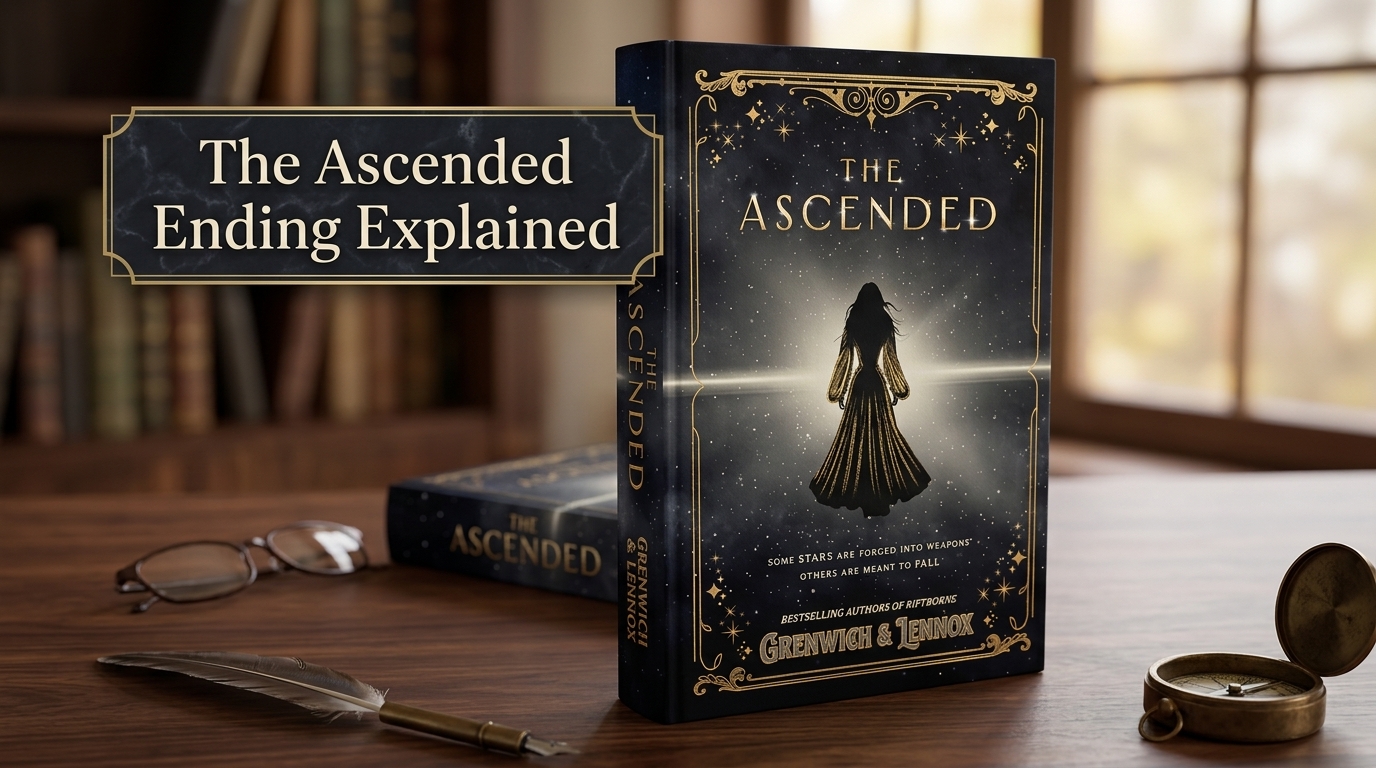
This is a full-spoiler explanation of how The Ascended by Bree Grenwich and Parker Lennox ends. If you’ve already finished the book and want the final chapters laid out clearly what happens to Thatcher, whether Olinthar is really Moros, why Thais kills her own father, who Aether is, and where that leaves her and Xül this covers it in detail.
If you haven’t finished the book, stop here.
The Ascended Ending Explained in Brief
- Olinthar’s body has secretly been controlled for years by Moros, the Primordial of Endings.
- Moros plans to abandon Olinthar’s body for Thatcher’s, because Thatcher’s power mirrors an ability the Primordials once had.
- Thais reaches Thatcher mid-ritual and wakes him through their twin bond; together they defeat Moros’s companion, Elysia.
- Thatcher forces Moros out of Olinthar’s body.
- Moros retaliates by dragging Thatcher into an abyss between realms as he retreats.
- Thais kills the now-vacated Olinthar and inherits his divine power and authority.
- In the abyss, Moros strips Thatcher’s memories until he no longer knows his own name.
- Queen Andrid Valtry finds him there and gives him a new name: Aether.
- Xül marries Nyvora to protect Thais politically, leaving their relationship unresolved.
For the complete story Thais’s discovery, the three Trials, and everything leading up to this see The Ascended Summary. This page covers the ending only.
What Happens at the End of The Ascended?
The Ascended ends with Thatcher lost to another realm, Olinthar dead, and Thais holding power she never asked for.
After the third trial, Thais ascends and loses her connection to the twin bond. Following what she believes is a path to Thatcher, she arrives instead at the ruins of the Primordial War, where Olinthar reveals the truth about himself. Before she can react, Moros’s companion Elysia stabs her. Xül, through a soul bond neither of them knew they’d formed, feels her pain and realizes something has gone wrong.
Thais finds Thatcher already mid-ritual Moros in the process of transferring his consciousness into Thatcher’s body. She reaches him through the twin bond and wakes him. Together they defeat Elysia, and Thatcher turns his power on Moros directly, forcing him out of Olinthar’s body. Moros doesn’t simply vanish: he tears open a rift resembling an abyss between realms and is pulled through it, dragging Thatcher with him as he vows to return.
As the rift closes, Olinthar briefly free of Moros’s control calls Thais “daughter” one last time. She kills him with a blade of starlight, and in doing so inherits his divine power and authority, taking his place among the Legends.
Is Olinthar Really Moros?
Olinthar’s body has been secretly controlled by Moros, the Primordial of Endings, for years a being the current pantheon believed they’d destroyed during the Primordial War. Olinthar and Moros aren’t the same person; Moros was possessing him.
For most of the book, both twins believe they’re dealing with their father, Olinthar, King of the Gods, directly. The ending reveals that Moros has been operating from inside his body, using his authority while working toward a longer-term goal: securing a new host. That host needs to be Thatcher specifically, because his power mirrors the exact kind of ability the gods thought had died out with the Primordials.
The reveal recasts a few earlier moments Olinthar’s unusually close interest in Thatcher during the second trial, his willingness to overlook Thais’s deception as Moros maneuvering, not a father’s protectiveness. The book doesn’t say how long Moros had been in control, so that detail is best treated as unclear rather than assumed. Get a Detailed Guide About Ascended Characters & Relationships.
What Happens to Thatcher at the End?
No, Thatcher does not die at the end of The Ascended. Moros pulls him into an abyss between realms, where he loses his memories, and he later resurfaces under a new name: Aether.
Here’s how that happens. Moros targets Thatcher because his power mirrors a Primordial ability the current gods believed was gone which makes Thatcher rare, and possibly the only viable body Moros can transfer into. Thais interrupts the transfer ritual and reaches Thatcher through their twin bond, waking him in time to fight back. It’s ultimately Thatcher’s own power that forces Moros out of Olinthar. That victory has a cost: rather than let him go, Moros drags Thatcher into the abyss during his retreat.
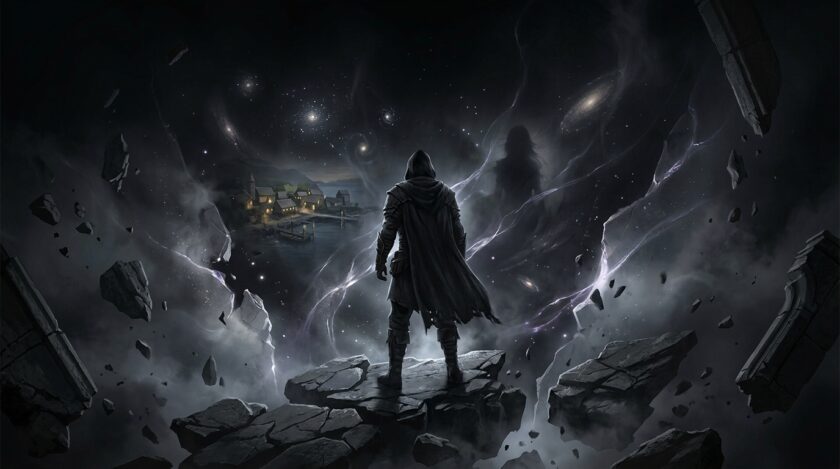
Once there, Moros begins consuming Thatcher’s memories Saltcrest, Sulien, his sister, eventually his own name. What survives is the twin bond itself. Stretched thin across the divide, it doesn’t fully break, which is the clearest sign the book gives that Thatcher’s connection to Thais isn’t completely gone, even after his memories are.
What’s confirmed versus left open: the book confirms Thatcher is alive, memoryless, and in another realm. It doesn’t confirm whether he’ll regain his memories, whether Moros retains any influence over him, or when if ever Thais reaches him again beyond the narrow window discussed below.
Does Thatcher Die in The Ascended?
No. Thatcher survives the final battle. Moros pulls him into the abyss between realms and strips his memories, but he doesn’t die he resurfaces afterward as Aether.
Who Is Aether in The Ascended?
Aether is the name given to Thatcher after Moros erases his memories in the abyss between realms.
Once there, Thatcher has no memory of who he is not his name, his sister, or anything from his life before the Trials. Queen Andrid Valtry, ruler of an unfamiliar realm, finds him there. Unable to tell her his name, she gives him one: Aether.
The reveal happens in the book’s final pages, presented as the direct result of Moros’s memory-stripping rather than a separate transformation. Aether is also the name of a character in Grenwich and Lennox’s earlier Espirithe trilogy (Riftborne and Duskbound), whose origin was previously unexplained — The Ascended reads as filling in that backstory. The exact extent of that connection, including what Aether does afterward, isn’t spelled out within The Ascended itself and shouldn’t be treated as fully confirmed without checking the earlier books directly.
What Happens to Thais at the End?
Thais ends the book alive, victorious, and grieving. Moments after losing Thatcher to the abyss, she kills Olinthar her own father with a blade of starlight, immediately after Moros is forced out of his body.
Killing him isn’t framed as simple revenge by that point. It’s what ends Moros’s hold on him for good and stops the ritual that was consuming her brother. In the process, she inherits Olinthar’s divine power and authority, stepping into the position he held among the Legends. That inheritance isn’t portrayed as a win it’s authority she didn’t seek, arriving in the same moment she loses her twin brother to another realm.
Are Thais and Xül Together at the End?
Not fully. Their relationship is left unresolved rather than concluded.
Xül’s father, Orthus, arranges his marriage to Nyvora earlier in the book for political reasons. Xül tells Thais his feelings for her haven’t changed, and the two reconcile before her ascension. But once Thais inherits Olinthar’s power, the political calculus shifts again: to protect her position and shield her from the fallout of holding that authority, Xül goes through with the marriage and becomes king. Thais rules beside him from a more guarded position rather than as his declared partner.
The marriage happens, and Xül maintains his feelings for Thais are unchanged but whether the arrangement is temporary, purely strategic, or a lasting complication is left open by the ending itself.
Why Does Moros Want Thatcher?
Moros wants Thatcher’s body because Thatcher’s power closely mirrors an ability the Primordials had the same kind of power the current gods believed they’d wiped out generations ago during the Primordial War.
That rarity is the whole reason Moros has been playing a long game inside Olinthar’s body instead of acting sooner. A body like Olinthar’s gave him authority and cover, but not the kind of power he actually wants. Thatcher’s power does. The ritual Thais interrupts is Moros attempting exactly that transfer abandoning Olinthar for something closer to what he originally had before the Primordials were destroyed.
What Does the Thread-of-Fate Revelation Mean?
Late in the book, a seer tells Thais that Thatcher’s “thread of fate” can be reached for seven seconds, once every thirty-six years.
That detail is presented exactly as stated a narrow, recurring window, not a guarantee. It reads as the book’s way of leaving room for Thais and Thatcher’s bond to matter again without promising a specific outcome. Nothing in The Ascended confirms the window will actually be used, successfully or otherwise, in a future book.
How Sad Is The Ascended Book Ending?
The ending is heavy less because of one devastating twist and more because several losses land at once.
Thatcher survives, but the version of him that existed through the book — Thais’s twin, Sulien’s son, the boy from Saltcrest — is effectively gone, replaced by someone with no memory of any of it. Thais gets him back from Moros’s ritual only to lose him again immediately, this time to an abyss with no clear return date. She kills her own father in the same breath, closing one wound while opening another. And her relationship with Xül, the one steady thing she’d built for herself through the Trials, gets complicated by politics right when she might need it most. None of these losses cancel each other out — they happen almost simultaneously, which is a large part of why the ending feels heavier than a single plot twist would.
What Does The Ascended Ending Mean?
One way to read this ending is around the gap between identity and memory: Thatcher survives physically, but Moros takes the one thing that made him him — everything he remembers — which raises the question of whether Aether is really Thatcher, or someone new wearing his face.
The ending can also be read through inheritance and unwanted power. Thais spends the entire book defining herself against Olinthar, only to end up holding his exact authority the moment he dies — not as a victory, but as a burden she absorbs because someone has to, and refusing isn’t really an option once Moros is gone and the position sits empty.
These readings are interpretation, not confirmed authorial intent — Grenwich and Lennox haven’t stated these themes explicitly in available source material; this is one way of reading what the text sets up, not the only one.
What Does The Ascended Ending Set Up?
Confirmed by the book:
- Thatcher is alive, in another realm, and known as Aether.
- Thais holds Olinthar’s former power and authority.
- Xül is married to Nyvora and has become king.
- A narrow, recurring window exists for reaching Thatcher’s thread of fate.
- Moros survived his expulsion from Olinthar’s body and stated he would return.
Possible implications, not confirmed:
- Aether’s appearance in the earlier Espirithe trilogy suggests his story continues beyond this book, though the exact connection isn’t fully spelled out here.
- Moros’s vow to return implies he remains a threat, though nothing confirms when or how.
- Whether Thais and Xül’s relationship develops further is left open.
Any specific sequel title, release date, or confirmed continuation of the Aesymarean Duet isn’t established within The Ascended itself and should be checked directly with the authors or publisher.
The Ascended Ending FAQ
What happens at the end of The Ascended?
Thais and Thatcher force Moros out of Olinthar’s body, but Moros drags Thatcher into an abyss as he retreats. Thais kills Olinthar and inherits his power, while Xül is bound to a political marriage that leaves their relationship unresolved.
Does Thatcher die in The Ascended?
No. He survives, though Moros pulls him into the abyss and strips his memories, and he resurfaces afterward as Aether.
Who is Aether in The Ascended?
Aether is the name given to Thatcher after Moros erases his memories in the abyss. Queen Andrid Valtry finds and renames him, and the reveal connects to a character of the same name in the earlier Espirithe trilogy.
Is Olinthar really Moros?
Olinthar’s body was secretly controlled by Moros, the Primordial of Endings, for years. They aren’t the same being Moros was possessing him.
What happens to Thais at the end?
She kills Olinthar after Moros is forced out of his body and inherits his divine power and authority — a position she didn’t seek, gained in the same moment she loses her brother.
Are Thais and Xül together at the end?
Not fully. Xül marries Nyvora for political reasons tied to protecting Thais’s new position, though he says his feelings for her haven’t changed.
Why does Moros want Thatcher?
Thatcher’s power mirrors an ability the Primordials had, one the current gods believed extinct — making him the rare, possibly only, viable host for Moros to transfer into.
How sad is The Ascended’s ending?
It’s heavy in layers rather than one twist: Thatcher’s memory loss, his separation from Thais, Olinthar’s death, and the Xül/Nyvora complication all land within the same final stretch.
What happens to Olinthar?
Once Moros is forced out, Olinthar briefly regains himself long enough to call Thais his daughter one last time. She then kills him with a blade of starlight.
What does the ending set up?
Thatcher’s survival as Aether, Moros’s vow to return, and Thais and Xül’s unresolved relationship all suggest the story continues, though The Ascended doesn’t confirm specific sequel details.

Hi, I’m Nisbah – a blogger with over 2 years of experience creating content and a fantasy enthusiast who loves exploring magical worlds, fantasy books, captivating stories, and unforgettable characters. I share book recommendations, reviews, fantasy insights, and story discussions and creating guides to help readers discover their next great adventure.