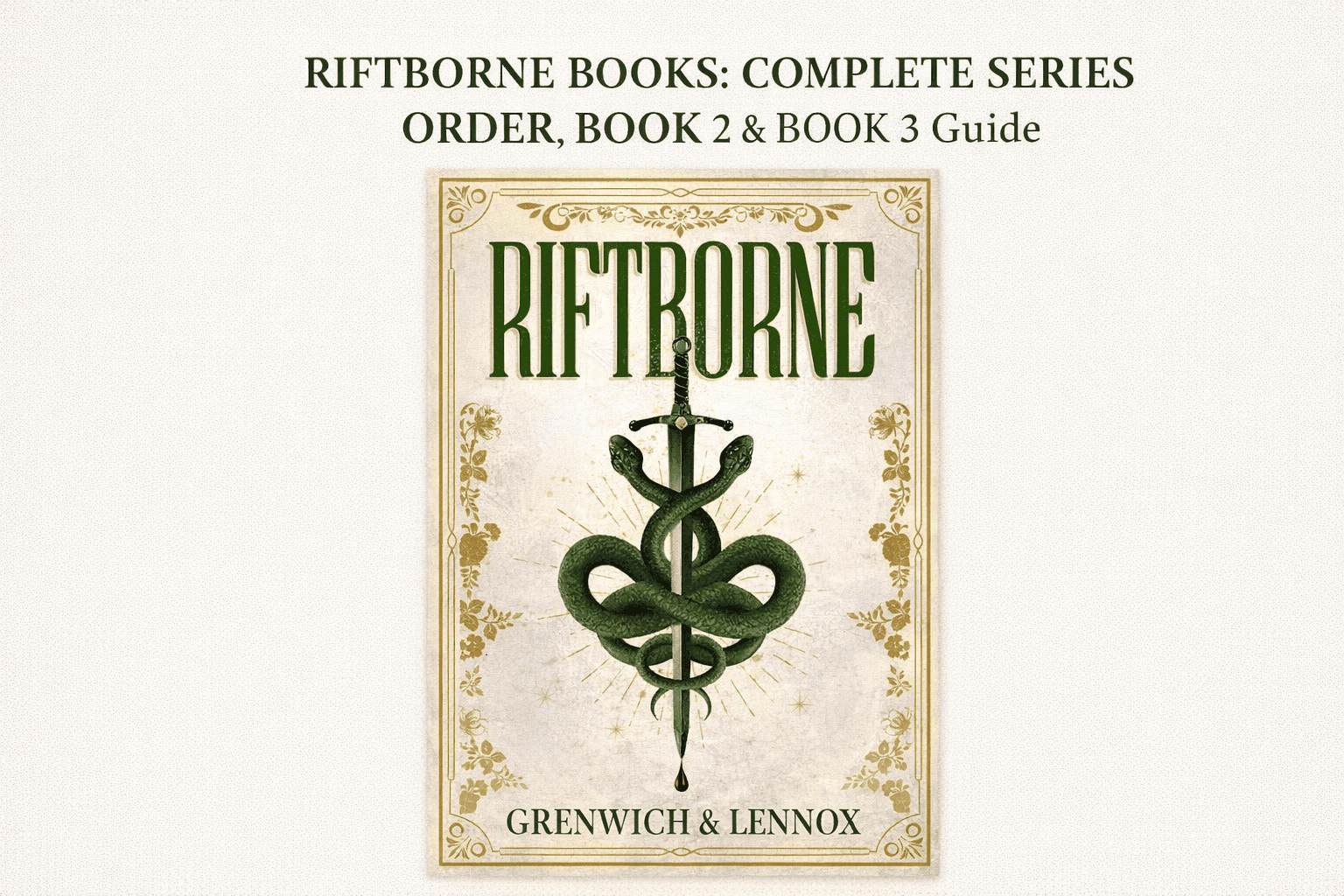


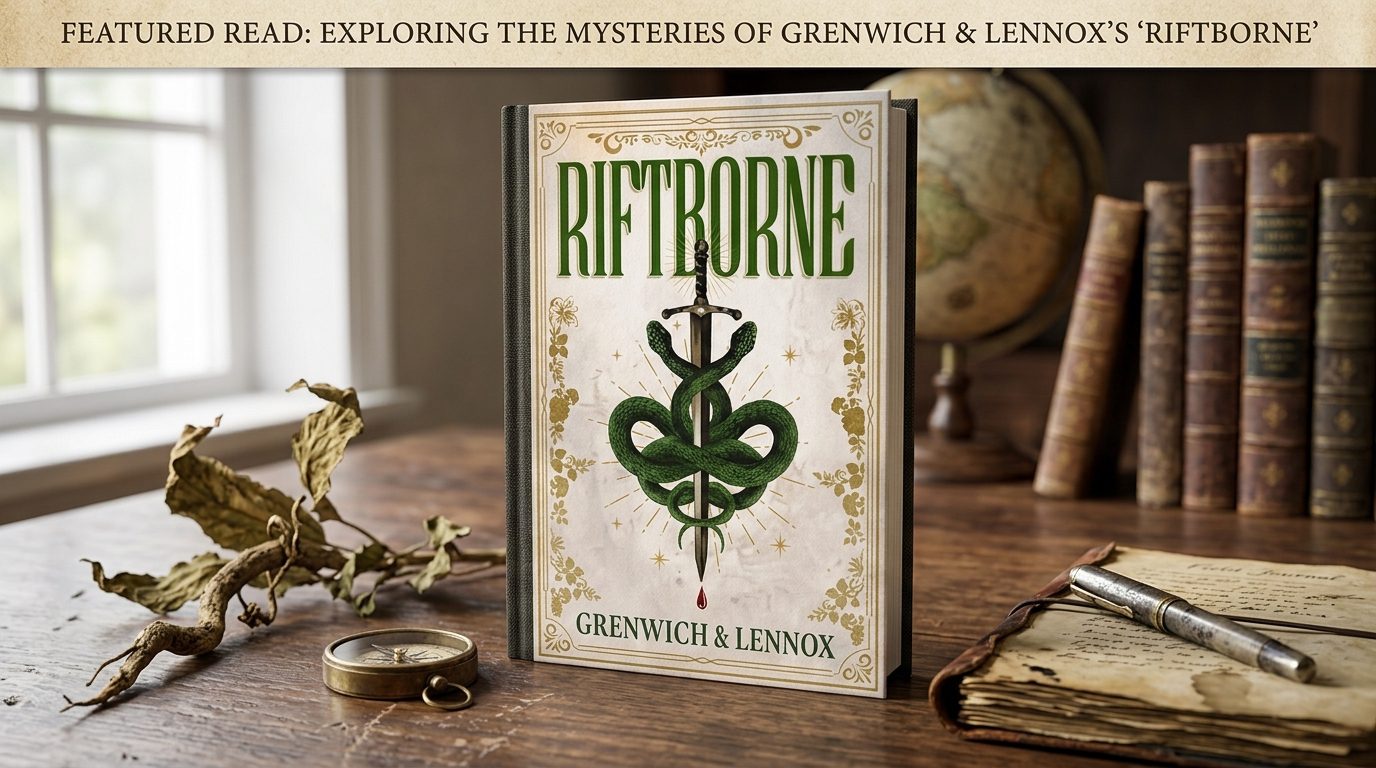
Riftborne is a fantasy romance novel by Bree Grenwich and Parker Lennox, and the first book in their Esprithean Trilogy. It follows Fia Riftborne, a woman hiding a dangerous power in a city built on prejudice against people like her, and Laryk Ashford, the Sídhe General who pulls her into his world instead of turning her in. It’s an enemies-to-lovers, slow-burn romantasy with political stakes, a magic system with real teeth, and a central relationship built on forced proximity and mutual distrust that slowly turns into something else.
This guide covers everything worth knowing about Riftborne: what it’s about, who Fia and Laryk are, how spicy it gets, what the tropes are, how it connects to Duskbound, and whether it’s actually worth your time.
A quick note before we start: this page stays spoiler-light. You’ll get enough to know what you’re getting into, but the ending and the twists in Duskbound are not spoiled here.
What Is Riftborne About?
Riftborne is set on the Isle of Sídhe, decades after a rebellion left the losing side branded as outcasts. Fia Riftborne is one of them. She’s spent her life keeping her head down, staying invisible, and avoiding the Sídhe Guard, the very people who conquered her family’s side of that rebellion.
The problem is that Fia has a power she can’t fully control, and it isn’t a small one. When it finally erupts in public, she expects to be punished or worse. Instead, General Laryk Ashford, the elusive commander building an elite unit of magic wielders to fight a growing threat on the western border, gives her a different choice: join the Sídhe Guard, or face execution.
From there, Fia is pulled into exactly the world she spent her whole life avoiding. She has to train under the general who represents the very system that branded her family as outcasts, figure out what her power actually is before it destroys her, and navigate a Guard that sees her as either a weapon or a liability. Meanwhile, wraiths are devouring the western border, the political situation on the Isle is fraying, and Fia’s growing feelings for Laryk complicate a relationship that began under the threat of execution.
It’s a story about hidden power, forced proximity, and what happens when the person meant to control you starts to matter to you instead.
Riftborne at a Glance
| Title | Riftborne |
| Authors | Bree Grenwich and Parker Lennox |
| Series | The Esprithean Trilogy |
| Book number | Book 1 of 3 |
| Genre | New Adult Romantasy, Adult Fantasy Romance, Epic Fantasy |
| Main character | Fia Riftborne |
| Main romantic interest | Laryk Ashford |
| Romance style | Enemies to lovers, slow burn |
| Spice level | Open-door, moderate (reader guides generally place it around 3/5) |
| Setting | Isle of Sídhe |
| Related book | Duskbound (Book 2), part of the same continuing story |
| Standalone status | No, ends on unresolved threads that lead into Duskbound |
Riftborne Summary
Fia Riftborne has spent twenty years surviving in a city that never let her forget which side her family was on. She’s careful, guarded, and used to being underestimated, which is exactly how she’s kept her secret power hidden for this long.
That changes the moment her power erupts and she can no longer hide what she is. Rather than the punishment she braces for, General Laryk Ashford makes her an offer that isn’t really a choice at all: join the Sídhe Guard’s unit of magic wielders, or die.
Fia chooses to live, which means training under the general commanding the very Guard that has policed people like her for decades, working alongside soldiers who see her as a threat, and trying to understand a power that keeps growing faster than she can control it. As the wraith threat on the western border worsens and political tension inside the Guard rises, Fia and Laryk are forced into closer and closer proximity. What starts as suspicion and resentment slowly shifts into something neither of them expected, and by the end of the book, Fia is no longer sure who she can trust, including herself.
The book closes with real stakes still unresolved, setting up the story that continues directly into Duskbound.
Who Is Fia Riftborne?
Fia Riftborne is the protagonist of Riftborne and the character the book is named after. She’s the daughter of the losing side of a rebellion that happened decades before the story starts, which makes her a branded outcast in a city that treats people like her with open hostility.

Growing up, Fia learned to survive by staying invisible. She keeps her head down, avoids attention, and does everything she can to stay off the radar of the Sídhe Guard, the military force that enforces the order her family’s rebellion tried to break. Underneath that careful exterior, though, she’s hiding a power she doesn’t fully understand and can’t fully control, one that’s been growing for years and finally erupts in a way she can’t take back.
That eruption forces her into the Sídhe Guard rather than away from it, and her arc through Riftborne is about learning to survive inside the exact system she spent her life avoiding. She has to figure out what her power is, what it means for her identity as a “Riftborne,” and how to function in a unit that doesn’t fully trust her. Her relationship with Laryk Ashford sits right at the center of that struggle. He’s both her commanding officer and the person most likely to understand what she’s going through, which makes the tension between them personal as much as it is dangerous.
Who Is Laryk Ashford?
Laryk Ashford is the Sídhe General and Fia’s main love interest in Riftborne. He commands the Sídhe Guard and is building an elite unit of powerful wielders to face the wraith threat devouring the western border, which is what puts him in Fia’s path in the first place.

Laryk is morally gray by design. He’s the one who gives Fia the ultimatum that changes her life, and he’s also the person training her to control the very power that makes her dangerous. He’s described as striking in a cold, almost dangerous way, unassuming until you’re close enough for it to matter. He doesn’t fit neatly into “hero” or “villain,” and that ambiguity is a big part of what makes the romance work: Fia doesn’t know if she should trust him, and for a long stretch of the book, neither does the reader.
As the story develops, Laryk becomes less of an authority figure and more of a person to Fia, someone whose motivations turn out to be more complicated than “enforcing the Guard’s rules.” The slow reveal of who he actually is, and why he’s building this unit in the first place, runs parallel to the romance itself.
Riftborne Romance
The Fia and Laryk romance is built on classic enemies-to-lovers mechanics, but it earns them instead of rushing through them. Fia starts the book with every reason to distrust Laryk. He represents the ruling system that branded her an outcast in the first place, and he’s the one holding her life in his hands when he offers her the choice to join the Guard or die. That’s not a meet-cute. That’s coercion dressed up as an opportunity, and the book doesn’t pretend otherwise.
From there, forced proximity does a lot of the work. Fia has to train under Laryk, report to him, and rely on him to help her understand a power that terrifies her. The “he trains her” dynamic gives the romance a natural, believable slow burn: trust builds in small moments before either character admits there’s anything else going on. Tension and resentment come first, then grudging respect, then something neither of them planned for.
What makes the romance work is that neither character has to become someone else for it to happen. Fia stays guarded and self-protective. Laryk stays morally gray and hard to read. The relationship develops because circumstances keep forcing them together, not because the plot needed a romance and inserted one.
Riftborne Tropes
| Trope | How It Appears |
|---|---|
| Enemies to lovers | Fia and Laryk start on opposing sides of a rebellion’s aftermath |
| Slow burn | The romance builds gradually across training, conflict, and forced proximity |
| Forced proximity | Fia is placed directly under Laryk’s command in the Sídhe Guard |
| He trains her | Laryk personally trains Fia to control her emerging power |
| Magical special ops | Laryk’s unit is built specifically around powerful wielders |
| Morally gray love interest | Laryk’s motives and methods are never fully clear-cut |
| Found family | Fia builds real bonds within the Guard despite her outsider status |
| Open-door romance | The romantic and physical relationship is shown on the page |
Is Riftborne Like Fourth Wing or ACOTAR?
Riftborne shares some DNA with Fourth Wing and ACOTAR, but it isn’t a clone of either. All three sit in the romantasy space and pair a powerful heroine with a high-stakes military or political world, which is why fans of one tend to find their way to the others.
The Fourth Wing comparison mostly comes from the training and Guard-unit structure. Like Violet in Fourth Wing, Fia is pushed into a demanding military environment she didn’t choose, has to prove herself among people who doubt her, and finds romance forming under pressure rather than in a safe, low-stakes setting. The ACOTAR comparison leans more on tone: a richly built fantasy world, political intrigue layered under the romance, and a slow reveal of how magic and power actually work in that world.
Where Riftborne stands apart is in its specifics. The setting is the Isle of Sídhe rather than a dragon-rider academy or a faerie court, and Fia’s status as a branded outcast from a defeated rebellion gives the story a different emotional starting point than either comparison title. The magic system also has its own flavor, with publisher marketing describing it as inspired by X-Men, built around individual “wielders” with distinct abilities rather than a single unified power source. If you liked Fourth Wing or ACOTAR for the training, the political stakes, or the slow-burn tension, Riftborne is worth picking up, but go in expecting its own world rather than a retread.
Is Riftborne Spicy?
Yes, Riftborne is an open-door romance, meaning the intimate scenes are shown rather than faded to black. That said, it’s a slow burn first, so the spice builds gradually and isn’t the main focus of the early chapters.
Because it’s a slow burn, the physical relationship between Fia and Laryk develops alongside the emotional one rather than ahead of it. This is an official trope of the book (open-door romance is part of the author’s own trope list), but the intensity level is more of a reader-guide judgment call than an official rating. Romance-focused reader guides generally place Riftborne around 3 out of 5 for spice, open-door but moderate rather than explicit throughout, though individual ratings vary from reader to reader. It reads as secondary to the tension, distrust, and training dynamic that defines most of the book, which is part of why the slow burn works. If you’re looking for a book that’s spicy from the first chapter, this isn’t it. If you want spice that pays off a long build of tension, Riftborne delivers that.
We’re not listing specific spice-chapter numbers here, since that kind of chapter-by-chapter detail deserves its own dedicated breakdown rather than a guess.
Riftborne Magic and Powers
Fia’s power is the central mystery of the book. It’s dangerous, unpredictable, and has been growing for years without her fully understanding what it is or why she has it. When it finally erupts in public, it’s powerful enough to put her life at risk and strong enough to catch Laryk’s attention immediately.
The wider magic system in Riftborne revolves around “wielders,” people with individual magical abilities powerful enough that the Sídhe Guard organizes an entire unit around training and containing them. Publisher marketing has described the system as inspired by X-Men, with each wielder carrying their own distinct ability rather than drawing from one shared source of magic. Fia’s power sets her apart even within that group, which is part of why Laryk is so determined to bring her in rather than let her power go unchecked. Learning to control it, rather than be controlled by it, is one of the core threads of her arc, and it’s tied directly into her growing relationship with Laryk, since he’s the one tasked with helping her manage it.
The World of Riftborne
The story is set on the Isle of Sídhe, a place still shaped by a rebellion that happened decades before the book begins. That history isn’t background noise. It defines how Fia is treated, why “Riftborne” functions almost like a branded label rather than just a surname, and why the political tension inside the Guard runs so deep.
The Sídhe Guard itself is the military and political force keeping order on the Isle, and it’s where most of the book’s tension plays out, both the political kind and the personal kind. Outside the walls of that structure, wraiths are devouring the western border, a growing threat that’s part of why Laryk is building his unit of wielders in the first place. Layered underneath all of it is a rebellion’s aftermath that hasn’t fully healed, prejudice against people branded like Fia, and a power structure that doesn’t trust the very people it now needs.
It’s a lot of moving pieces, but the book introduces them gradually through Fia’s perspective rather than front-loading a wall of lore, which keeps the worldbuilding from feeling like homework.
Riftborne Content Warnings
Riftborne is a darker fantasy romance, and readers who prefer to check content warnings before starting a book may want to know what to expect going in. Broadly, the story touches on violence and warfare, prejudice and discrimination against a branded group, death, captivity or imprisonment-adjacent themes, and other darker fantasy-romance material tied to its political and military setting. As with any romantasy pick, if you’re sensitive to any of these themes, it’s worth doing a quick check of a dedicated content-warning resource before diving in.
Riftborne and Duskbound: What’s the Connection?
Riftborne and Duskbound are Book 1 and Book 2 of the same continuing story, the Esprithean Trilogy. Duskbound picks up directly where Riftborne leaves off, meaning Riftborne should be read first. This isn’t a series where each book stands alone with a new cast; it’s one ongoing story split across three books.
Without spoiling either book, Duskbound raises the stakes significantly from where Riftborne ends. Fia’s situation changes in a major way early in Duskbound, and the political and magical conflict that was building in Riftborne becomes far more central. If you finish Riftborne and want to know what happens next, Duskbound is the direct continuation, not a spinoff or a side story.
Both books are also part of the wider Sundered Realms Extended Universe, a shared universe that connects to other series by the same authors, though the Esprithean Trilogy functions as its own self-contained story within it.
Riftborne Series Order
The Esprithean Trilogy is the series Riftborne belongs to, and it currently consists of:
- Riftborne (Book 1)
- Duskbound (Book 2)
- Realmblade (Book 3, the planned conclusion to the trilogy)
Riftborne Books: Complete Series Order, Book 2 & Book 3 Guide
Read them in that order. Riftborne is the entry point, and Duskbound and Realmblade continue Fia’s story directly rather than jumping to new characters or a new timeline.
The Esprithean Trilogy also sits inside the broader Sundered Realms Extended Universe, a shared world Grenwich and Lennox use across their books. You don’t need to read anything else in that wider universe to understand Riftborne, but it’s worth knowing the trilogy isn’t fully isolated from the authors’ other work if you want to keep exploring the world afterward.
Is Riftborne a Standalone?
No, Riftborne is not a standalone. It’s the first book in a three-book trilogy, and it ends with real threads left unresolved rather than wrapping up cleanly. The central conflict around Fia’s power, the wraith threat, and the political tension within the Guard all carry forward into Duskbound.
There’s a meaningful cliffhanger element by the end, enough that you’ll want the next book close by. It doesn’t leave the story mid-scene, but it also doesn’t give you a tidy, closed ending. If you prefer books that resolve fully on their own, know going in that Riftborne is built to lead you into Duskbound, not to stand apart from it.
You don’t need to have read anything else beforehand to start Riftborne. It’s the true beginning of the trilogy, so no prior books are required.
Riftborne Review: Is It Worth Reading?
Riftborne earns its comparisons to Fourth Wing and ACOTAR, but it’s not a carbon copy of either. Its biggest strength is the slow burn itself: the enemies-to-lovers dynamic between Fia and Laryk is given real room to develop, built on forced proximity and training rather than instant chemistry, and it pays off in a way that feels earned rather than rushed.
The worldbuilding is layered in gradually, which works well for readers who don’t want a heavy lore dump in the opening chapters, though it also means some of the political and magical stakes take a little while to fully click into place. Fia is a compelling lead precisely because she’s guarded and cautious rather than instantly heroic, and her arc around learning to control her power doubles as an arc about learning to trust people again. Laryk’s morally gray characterization keeps the romance from feeling predictable, since his motivations aren’t handed to the reader early.
Pacing is where opinions split a little. The slow burn is a strength for readers who want tension over instant gratification, but readers looking for faster plot movement or earlier spice may find the build takes longer than expected. The ending sets up Duskbound clearly, with unresolved stakes rather than a full resolution, which works well if you’re planning to continue the series but may frustrate readers who prefer standalone closure.
That read lines up with how the book has actually landed with critics and readers. Buzzfeed’s coverage singled out its “slow burn spice that’s worth the torture,” and HuffPost Books contributor Emily Bond called it “your next addictive series” in a review comparing Grenwich and Lennox to Sarah J. Maas and Rebecca Yarros. Independent book blog reviews have been more measured: The Escapist Book Blog said they were “pleasantly surprised by how easily” the story pulled them in despite going in with lowered expectations, while Scattered Thoughts and Rogue Words landed on a 3.75-out-of-5 rating, praising the included maps and terminology glossary while noting it still reads like a debut in places. Reader sentiment on Goodreads and across retailer review sections skews strongly positive, with one widely repeated reaction to a “spicy dreamwalk” scene showing up again and again, though a smaller share of readers have flagged the opening chapters as slow to hook them.
Overall, Riftborne is a strong start to a romantasy trilogy that knows what its readers want: a slow-burn enemies-to-lovers romance, political stakes that matter, a magic system with real consequences, and a morally gray love interest worth the wait.
Who Should Read Riftborne?
Riftborne is a strong fit if you enjoy:
- Slow-burn enemies-to-lovers romance
- Forced proximity and “he trains her” dynamics
- Morally gray love interests
- Political fantasy with real stakes
- Found family within a military or training structure
- Romantasy in the vein of Fourth Wing or ACOTAR
It’s less of a fit if you want a fast-paced plot from page one, an instant-spice romance, or a fully standalone story with no cliffhanger. If those describe your reading preferences, Riftborne is built to lead you further into its trilogy rather than wrap up in one book, so go in expecting a continuing story.
Frequently Asked Questions
What is Riftborne about?
Riftborne follows Fia Riftborne, a branded outcast hiding a dangerous power, who is pulled into the Sídhe Guard by General Laryk Ashford after her power erupts. It’s an enemies-to-lovers romantasy about training, trust, and a slow-burn romance set against a growing political and magical threat.
Who is Fia Riftborne?
Fia Riftborne is the protagonist of the book. She’s the descendant of the losing side of a rebellion, branded as an outcast, and hiding a powerful, uncontrolled ability that changes the course of her life once it’s discovered.
Who is Laryk Ashford?
Laryk Ashford is the Sídhe General and Fia’s main love interest. He’s morally gray, commands the Guard’s unit of magic wielders, and is the one who offers Fia the choice to join rather than face execution.
Is Riftborne spicy?
Yes, Riftborne is an open-door romance, meaning intimate scenes are shown on the page. It builds gradually since the book is a slow burn, so spice increases as the romance develops rather than appearing early and often.
How spicy is Riftborne?
It’s moderate, open-door romance. Romance-focused reader guides generally place it around 3 out of 5 for spice, though this is a reader-guide assessment rather than an official rating, and individual impressions vary. It’s not the focus of the early chapters, since the slow burn structure means tension builds for a while before the spice arrives.
Is Riftborne like Fourth Wing?
Not exactly, but it shares real similarities: a powerful heroine, a demanding military training environment, and romance that builds under pressure. Riftborne has its own setting on the Isle of Sídhe and its own X-Men-inspired magic system, so it’s a fit for Fourth Wing fans without being a copy of it.
Is Riftborne a standalone?
No. Riftborne is Book 1 of the Esprithean Trilogy and ends with unresolved threads that continue directly into Duskbound.
What is the Riftborne reading order?
Read Riftborne first, followed by Duskbound, then Realmblade, the planned third and final book in the trilogy.
Is Riftborne worth reading?
Yes, if you enjoy slow-burn enemies-to-lovers romantasy with political stakes and a morally gray love interest. It’s less suited to readers who want fast pacing or a fully resolved standalone story.
Who wrote Riftborne?
Riftborne was written by Bree Grenwich and Parker Lennox, co-authors of the Esprithean Trilogy.

Hi, I’m Nisbah – a blogger with over 2 years of experience creating content and a fantasy enthusiast who loves exploring magical worlds, fantasy books, captivating stories, and unforgettable characters. I share book recommendations, reviews, fantasy insights, and story discussions and creating guides to help readers discover their next great adventure.