
In film and theatre, drama and melodrama are often confused, but the distinction is actually quite clear when you look closely at how stories handle emotion. From my own experience watching and studying performances, the core difference really lies in how feelings are expressed and how realistic the story feels to the audience. Let’s get to know about Drama vs Melodrama – What’s the Difference? with complete guide.
- Drama usually centers on realistic characters, where subtle emotion and moral complexity shape a narrative that feels close to real life—rich, honest, and layered, allowing viewers to connect quietly but deeply.
- Melodrama, on the other hand, leans into overstated emotions, sensational plots, and strong divisions between good and evil, as it cranks up the volume on feelings and circumstances for striking effect, creating an immediate and powerful emotional response.
At its core, the difference between drama and melodrama lies in how emotions are expressed and how realistic the story feels.What Is Drama? Unpacking the Foundation of Great Storytelling
For many writers and performers, Drama is the go-to form when crafting scripts that feel real, honest, and alive. When you write work that holds a mirror to life, it naturally keeps audiences leaning forward, and that understanding becomes a non-negotiable skill for any playwright. At its heart, drama demands believable choices, flawed protagonists, and high stakes that reflect the messy complexity of real life, turning storytelling into the act of putting human truth on every page. This is why top dramas like Death of a Salesman and A Doll’s House, along with emotionally charged screenplays such as Manchester by the Sea, continue to resonate.
How Meaning Is Built on Stage and Screen
- Character move grows from clear wants, layered motivations, and authentic struggles that ring true as the story unfolds on stage or screen.
- Drama leaves interpretation open and invites the audience to engage, never spoon-feeding emotion.
- Subtle lines, pauses, and silences build tension, forcing viewers to reflect long after the curtain falls.
- Both internal and external conflict drive each scene, where dialogue stays sharp, natural, and necessary—overwrought or on-the-nose lines don’t belong.
- True drama lands when every conflict, choice, and emotional beat echoes real stakes, never plot for plot’s sake.
What Is Melodrama? Understanding the Heightened Art of Emotion
In theatre, melodrama is a powerful tool that delivers instant engagement and cranks up the volume on feeling, plot, and clarity. Playwrights often use it for young audiences, parodies, high-energy shows, or stories built on major conflict. Unlike subtle scripts, melodrama trades complexity for clear moral divides, letting the audience instantly recognize heroes and villains from the first scene, whether in silent film, mustache-twirling, or unapologetic cliffhangers in soap operas.When to Use Melodrama in Theatre
- Characters in melodrama are big, with grand gestures, tears, and declarations, where every emotion is obvious.
- Twists like hidden identities, lost wills, or shocking reversals keep tension high.
- Sensational scenarios open the door to catharsis, inviting the audience to react in real time—they don’t need to think, only feel.
- Iconic melodrama appears in telenovelas, Bollywood blockbusters, classic thrillers, and crowd-pleasing comedies that riff on familiar tropes.
- Melodrama works when a script needs fast connection, moral certainty, or commentary on genre.
- It moves mountains of stakes, huge emotions, and huger waves, letting the audience ride every beat of the story.
Drama vs Melodrama: Comparison Table
Aspect | Drama | Melodrama |
|---|---|---|
Emotional Style | Subtle and natural | Heightened and exaggerated |
Characters | Complex and realistic | Clearly good or evil |
Acting Style | Controlled, realistic | Expressive, dramatic |
Storytelling | Focuses on realism | Focuses on emotional impact |
Audience Reaction | Thoughtful, emotional connection | Strong emotional response |
Common Examples | Serious films, stage plays, TV dramas | Soap operas, classic theatre, telenovelas |
Examples of Drama vs Melodrama
A drama might show a character silently struggling with a difficult decision, allowing the audience to understand their emotions through dialogue and behavior. A melodrama, on the other hand, would highlight the same struggle with tears, dramatic speeches, and intense reactions to ensure the emotion is unmistakable.
Neither approach is wrong — they simply serve different storytelling purposes.
Acting Style Differences: Drama vs Melodrama
In drama, actors are expected to perform with restraint. Small gestures, facial expressions, and pauses carry meaning. Overacting can break the realism.
In melodrama, expressive movement, strong vocal delivery, and visible emotion are encouraged. The performance is meant to be seen and felt clearly, even from a distance, especially in traditional stage settings.
Which One Is Better?
Drama is often praised for its realism, while melodrama is sometimes criticized for being “over the top.” However, neither is better by default. The effectiveness depends on the story, audience, and purpose.
Melodrama can be powerful when the goal is emotional intensity, while drama works best when the aim is authenticity and depth.
When to Use Drama vs Melodrama
- Use drama when telling realistic stories about human relationships, personal struggles, or social issues.
- Use melodrama when you want strong emotional reactions, clear moral messages, or heightened storytelling.
Writers, performers, and directors often blend both styles in modern storytelling to balance realism with emotional impact.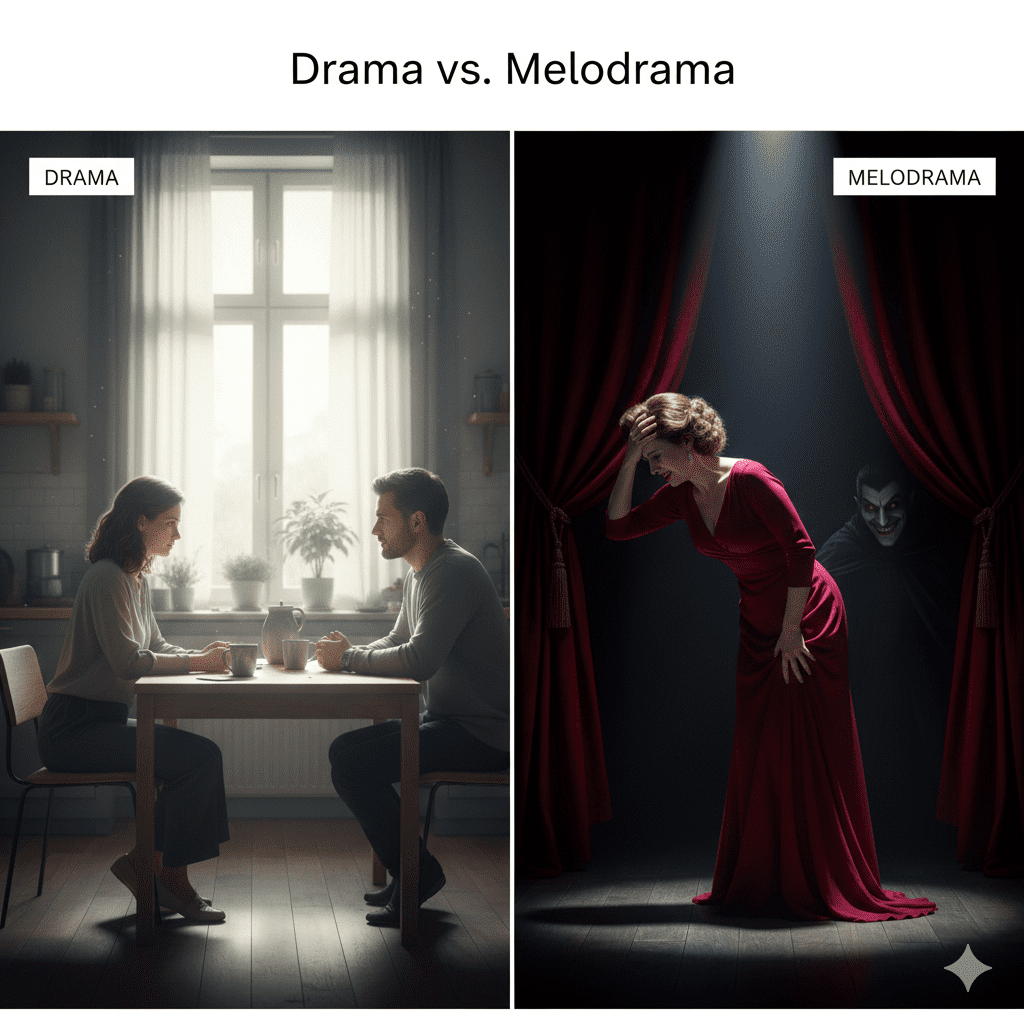
Common Misunderstandings About Melodrama
One of the biggest myths is that melodrama equals bad acting. In reality, melodrama is a deliberate style, not a mistake. When done well, it can be just as engaging and meaningful as drama.
Another misconception is that melodrama is outdated. While its classic form is older, modern media still uses melodramatic elements to captivate audiences.
Drama vs Melodrama in Modern Storytelling
Today, many films and series combine drama and melodrama. A story may feel realistic overall but include moments of heightened emotion for impact. This blend reflects how storytelling continues to evolve while borrowing from both traditions.
Why This Difference Matters
Understanding drama vs melodrama helps viewers appreciate stories more deeply, allows actors to perform more effectively, and enables writers to choose the right tone for their work. Knowing the difference isn’t about judging quality — it’s about recognizing style, intent, and emotional delivery.
Drama vs Melodrama in Hollywood: Real Industry Examples
Hollywood offers some of the clearest examples of how drama and melodrama work in practice.
A strong example of drama is Manchester by the Sea (2016). Casey Affleck’s performance relies on silence, restraint, and internal conflict. The grief is not loudly expressed — it’s felt through small reactions, pauses, and understated dialogue. This is classic dramatic storytelling where realism and emotional truth matter more than spectacle.
In contrast, melodrama is clearly visible in films like Titanic (1997). The emotions are intentionally heightened — sweeping music, intense declarations of love, clear heroes and villains, and dramatic moments designed to move the audience deeply. The film embraces melodramatic elements to create a powerful emotional experience rather than strict realism.
Related Post
What Famous Filmmakers Say About Emotion in Storytelling
Legendary director Alfred Hitchcock, often associated with suspense and emotional control, once explained the difference indirectly through storytelling intent:
“Drama is life with the dull bits cut out.”This idea reflects drama’s focus on meaningful, realistic moments rather than exaggerated emotion.
On the other hand, acclaimed director Pedro Almodóvar, known for modern melodrama, has openly embraced heightened emotion in his films, showing that melodrama is not a flaw but a conscious artistic choice. His work proves that emotional intensity, when intentional, can be just as powerful and respected as realism.
Examples from Theater, Film, and TV: Bringing the Differences to Life
- Drama often unfolds slowly, revealing each character’s heartbreak, as seen in Death of a Salesman and Manchester by the Sea.
- In drama, the audience sits with grief, experiencing a lesson grounded in real life.
- Melodrama cranks up volume on feeling and plot, turning amnesia, lost inheritances, and secret siblings into epic twists.
- Iconic melodrama examples include Grey’s Anatomy, early silent movies, and dramatic declarations in the rain.
- Audiences expect a certain pace, tone, and shape for each genre, but storytellers can subvert this when ready, applying basics while mastering heightened emotion.
Plot Devices and Structure: Navigating Realism and Sensation
- Drama actions follow logically from the last, with careful build, cause and effect, and stakes that feel earned.
- Example: A Doll’s House – twists shock, but every decision resonates with meaning.
- Melodrama allows wild swings: lost relatives found, villains exposed, and fate delivering decisive blows.
- Melodrama plot bends for maximum thrill, even if logic wobbles.
- Drama endings are open, with messy resolutions and space for doubt.
- Melodrama favors closure, justice, or poetic balance, even if reality bends.
- Controlling the plot allows you to guide audience expectations, letting them feel every dramatic beat.
Conclusion
Understanding the difference between drama and melodrama helps you see stories more clearly and perform them more effectively. Drama connects through realism and subtle emotion, while melodrama reaches audiences through heightened feeling and clear emotional signals. Neither style is better than the other — each serves a different purpose. When you recognize how and why they’re used, you can appreciate storytelling, acting, and film on a deeper level.
- What is the best example of melodrama?
One of the best examples of melodrama is Titanic, directed by James Cameron. The film heightens emotions through intense romance, sacrifice, and tragedy. Melodrama typically emphasizes dramatic music, moral contrasts, and exaggerated emotional conflict to deeply move the audience.
- Is Titanic an example of melodrama?
Yes, Titanic is widely considered a melodrama. While it is also a historical romance and disaster film, its emotional intensity, tragic love story, and dramatic sacrifice align strongly with melodramatic storytelling techniques.
- What is the difference between melodramatic and overdramatic?
Melodramatic refers to a storytelling style that intentionally heightens emotions for dramatic effect, especially in film or theatre. Overdramatic, however, describes someone reacting with unnecessary or excessive emotion in real life. Melodrama is a creative style; being overdramatic is often seen as exaggerated behavior.
- What’s the difference between being dramatic and melodramatic?
Being dramatic means expressing strong emotions or reactions. Being melodramatic means exaggerating emotions beyond what the situation requires. In storytelling, melodrama is purposeful and artistic, but in everyday life, it may feel unrealistic or excessive.