If you have ever held a Marvel issue in one hand and a manga volume in the other, you already know something feels different. It is not just the art style. It is the size. Comic book dimensions shape the entire reading experience the pacing, the panel flow, the weight of a splash page. Getting them wrong, even by a quarter of an inch, can ruin an entire print run before a single reader turns page one.
Whether you are a collector storing longboxes, a creator prepping your first self-published issue, or a designer setting up files for a print vendor, this guide covers everything. We are talking history, specs, bleed zones, paper weights, digital formats, and printing standards all in one place. No fluff. Just what you actually need to know.
Why Comic Book Dimensions Most Important Than You Think
Getting the standard comic book size right is not just a technical formality. It is the foundation every successful comic is built on. The wrong dimensions can mean your art gets cropped at the printer, your pages refuse to fit retail bags and boards, or your issue gets rejected by distributors entirely.
The Hidden Cost of Getting Comic Book Size Wrong
Here is a real scenario. An indie creator prints 500 copies of their debut issue. Beautiful art. Strong story. But they used a 7″ × 10.5″ trim instead of the industry standard 6.625″ × 10.25″. Every copy comes back with speech bubbles sliced at the edges. Reprint costs wipe out their launch budget. That one-quarter-inch mistake cost them thousands. Print specifications and bleed area are not optional details they are the difference between a professional product and an expensive lesson.
Beyond print, dimensions affect comic book storage, comic book grading, and even how retailers shelve and display your work. Standard sizing exists because the entire ecosystem from comic book retailers to comic distributors is built around it.
What Is the Standard Comic Book Size?
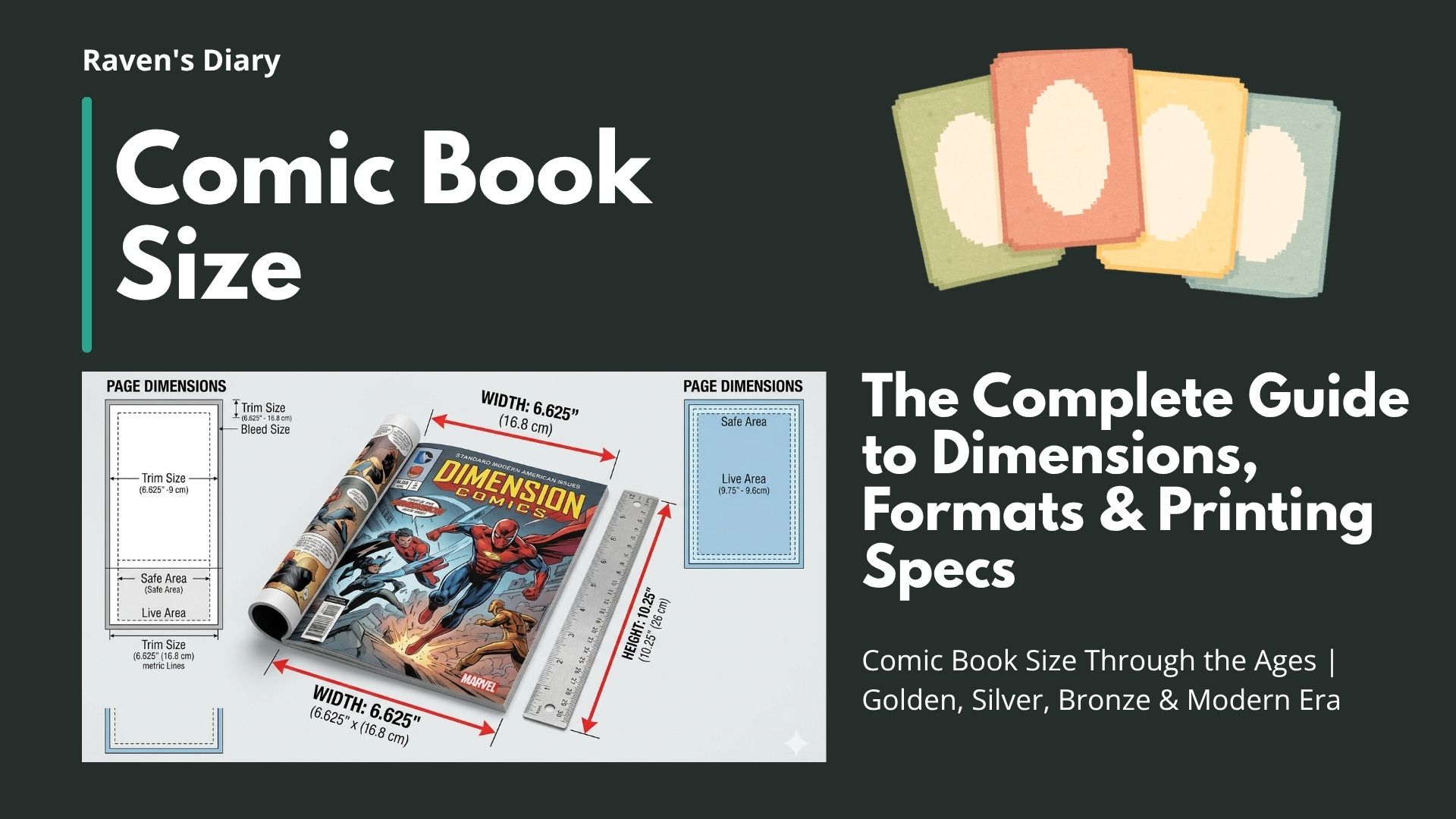
The standard comic book size used across the US market today is 6.625 inches wide by 10.25 inches tall that is the trim size, meaning the final cut dimensions after printing. However, your print-ready comic files must always be larger than the trim to account for bleed and safety margins.
| Spec | Measurement (Inches) | Measurement (MM) |
|---|---|---|
| Trim Size | 6.625″ × 10.25″ | 168mm × 260mm |
| Bleed Size | 6.875″ × 10.5″ | 175mm × 267mm |
| Safe / Live Area | 6.125″ × 9.75″ | 155mm × 248mm |
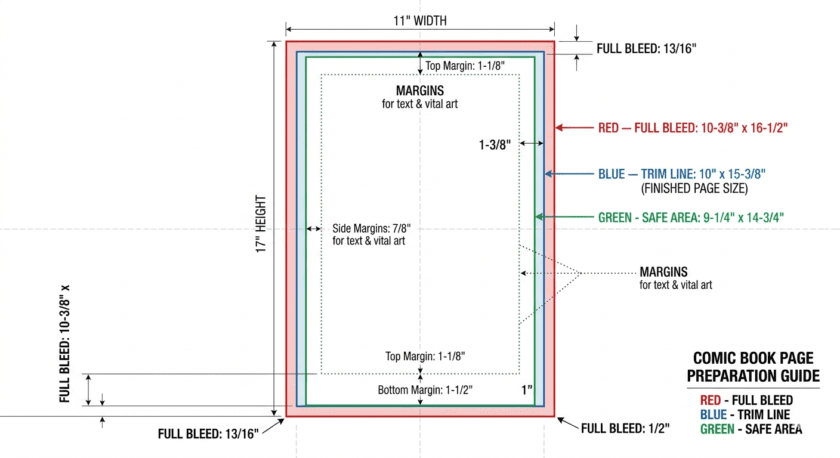
This is what what size are comic books comes down to in print production three concentric zones, each with a specific purpose. Knowing all three is non-negotiable if you are serious about comic page setup for print.
Trim Size vs. Bleed vs. Safe Zone | What’s the Difference?
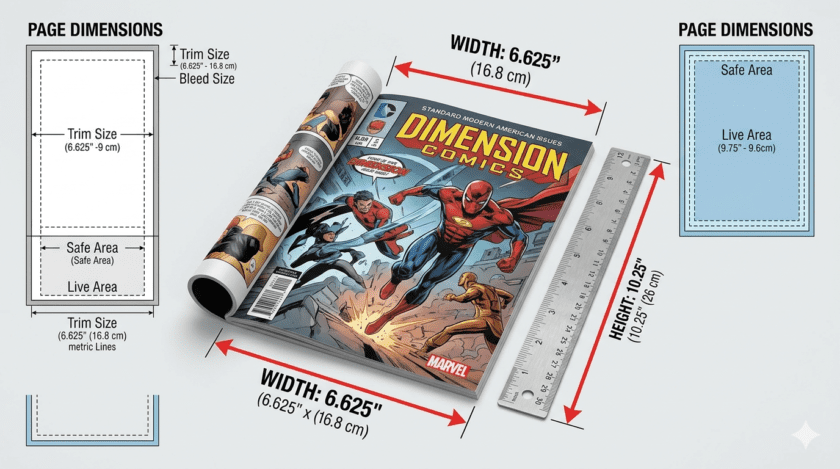
Think of it this way. The trim size is the finished page after the printer cuts it. The bleed area is extra artwork extending 0.125 inches beyond that cut line it exists because industrial cutters are not surgical instruments. Without bleed, a slightly off-cut leaves a thin white border that looks terrible. The safe area also called the live area is your buffer zone inside the trim. Keep all critical art, speech bubble placement, and text at least 0.25 inches from the trim edge. Anything that matters narratively must stay inside the safe zone. Always.
Comic Book Size Through the Ages | Golden, Silver, Bronze & Modern Era
Comic book dimensions were not always what they are today. The history of comic book size is really the history of the publishing industry learning to balance storytelling ambition with economic reality. Each era shrank the page slightly and with it, forced artists to adapt.
How Standard Comic Dimensions Shifted Decade by Decade
Golden Age comics (1938–1956) were enormous by today’s standards. Early issues like Action Comics #1 measured roughly 7.75″ × 10.5″ almost tabloid territory. Silver Age comics (1956–1970) began the slow contraction. Publishers started trimming costs. Pages got slightly narrower. Then Bronze Age comics (1970–1985) pushed further. Paper costs spiked, printing technology improved, and the page inched closer to what we use today. By the Modern Age comics era (1985–present), the industry standard trim size of 6.625″ × 10.25″ had locked in. Marvel and DC both adopted it. Comic book printing vendors standardized around it. That is the comic book evolution in a single measurement from tabloid ambition to a precision specification designed for retail and distribution compatibility.
Understanding Page, Trim, Bleed & Safe Area Dimensions
Every professional in comic book printing works within four distinct spatial zones on every page. Understanding each one is the foundation of a solid prepress setup and a clean print production workflow. If you are asking how big is a comic book page in practical terms, the answer is: it depends on which zone you are measuring.
A Creator’s Quick-Reference to Comic Book Page Specs
The bleed area exists because of a basic mechanical reality paper shifts slightly on press. Without artwork extending past the trim line, even a tiny shift leaves a white gap at the edge of your printed page. That 0.125-inch bleed extension costs you nothing. Ignoring it costs you everything. The gutter margin roughly 0.25 inches on each interior side is equally important for bound editions. Too little gutter and your art disappears into the spine. Think of gutters as the page’s breathing room.
These are the comic page dimensions for printing that every creator must memorize before sending anything to a vendor.
Standard Comic Book Paper Dimensions & Art Board Size Explained
Here is something many first-time creators do not realize. The page you read is not the same size as the page the artist drew on. Traditional comic book printing follows a rule called the 1.5× scale original artwork is drawn larger than the final printed page, then reduced. That reduction sharpens linework, tightens details, and hides minor inconsistencies in inking.
What Size Should Your Comic Art Board Actually Be?
The standard art board dimensions for traditional comic production are 10″ × 15″ or more commonly 11″ × 17″. Both give you the correct scale-down ratio to hit the standard comic book size at print. For Bristol board the professional surface of choice look for 300gsm weight with a smooth or vellum finish depending on your inking style. Brands like Strathmore 300 Series and Blue Line Pro art boards come pre-printed with non-photo blue panel guides so you can lay out pages without manual measurement. If you are working digitally, set your canvas at 300 DPI at the full bleed dimensions 6.875″ × 10.5″ and you are already aligned with professional printing standards.
| Drawing Method | Recommended Art Board Size | Notes |
|---|---|---|
| Traditional (pencil/ink) | 11″ × 17″ | Scaled down ~1.5× at print |
| Traditional (compact) | 10″ × 15″ | Slightly tighter but workable |
| Digital | 6.875″ × 10.5″ at 300 DPI | Print-ready comic files from day one |
Popular Comic Book Formats & Their Exact Dimensions
Not every comic is a standard single issue. The comic book format size varies significantly across the different publication types and each format comes with its own comic book measurements, binding style, and production considerations. Knowing them all matters whether you are a collector, creator, or retailer.
From Single Issues to Graphic Novels | Size Specs for Every Format
The single issue is what most people picture when they think of a comic. But the industry runs on a much wider range of formats. Trade paperback size for comics typically matches the standard trim dimensions but collects multiple issues. Graphic novel dimensions push wider and taller for premium shelf presence. Digest formats pack more story into a compact, manga-adjacent size that reads fast on the go.
| Format | Comic Book Dimensions | Typical Page Count | Binding Types |
|---|---|---|---|
| Standard Single Issue | 6.625″ × 10.25″ | 22–24 pages | Saddle stitch |
| Digest Comic Size | 5.5″ × 8.5″ | 100+ pages | Perfect binding |
| Trade Paperback | 6.625″ × 10.25″ | 120–200 pages | Perfect binding |
| Hardcover OGN | 7″ × 10.875″ | 100–300 pages | Case binding |
| Treasury Edition | 10″ × 13.5″ | 80–100 pages | Saddle stitch |
| Prestige Format | 8.5″ × 11″ | 48–64 pages | Perfect binding |
Each of these formats has its own comic page size logic. The prestige format, for example, was DC’s answer to giving flagship stories a premium feel thicker paper, square binding, no ads. Knowing which format suits your story is as much a creative decision as a comic print file dimensions decision.
US Comics vs. Manga vs. International Formats A Size Comparison
The US comic format is not the only standard in the world. Far from it. Manga size vs comic size is one of the most common questions in the self-publishing space — and for good reason. The two formats reflect fundamentally different reading cultures, distribution systems, and production traditions.
Why Japanese Manga and European Bandes Dessinées Use Different Sizes
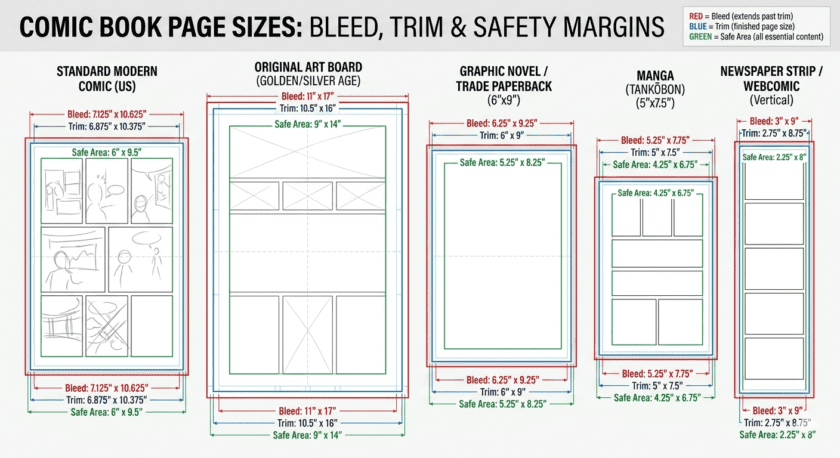
Japanese manga format specifically the Tankobon collected volume measures just 5″ × 7.5″ (128mm × 182mm). That compact size fits the Japanese pocket culture and high-density urban transit lifestyle. Readers flip pages right-to-left, the art is typically black-and-white, and the page count runs 180–220 pages per volume. European comic albums, or bande dessinée dimensions, sit on the opposite end of the scale. A standard BD album runs roughly 8.5″ × 11.75″ close to A4 with full-color artwork and a landscape-friendly page ratio.
British anthology comics like 2000 AD carry a tabloid legacy that still influences their slightly oversized page format today. Webtoon format and vertical scroll comics break the mold entirely designed for mobile screens, they use an 800px-wide canvas with infinite vertical scrolling and no traditional page structure at all.
| Region | Format Name | Comic Book Dimensions |
|---|---|---|
| USA | Standard Single Issue | 6.625″ × 10.25″ |
| Japan | Japanese Manga Format (Tankobon) | 5″ × 7.5″ |
| Europe | European Comic Albums (BD) | 8.5″ × 11.75″ |
| UK | Anthology (2000 AD style) | ~8.25″ × 11.5″ |
| Digital | Webtoon Format | 800px wide, variable height |
Manga dimensions favor intimacy. Graphic novel dimensions in the European tradition favor grandeur. The US comic format sits between them wide enough for dramatic splash pages, compact enough for newsstand racks and longboxes.
Mini Comics, Oversized Editions & Experimental Formats
Not every creator wants to fit inside the standard box. Mini comics, ashcan editions, and treasury-scale oversized formats all have their place in indie comic publishing and each comes with its own comic book measurements and production logic.
When Creators Break the Mold Intentionally
Mini comics are the DIY backbone of self publishing comics. Typically measuring 4.25″ × 5.5″ a simple half-letter fold they are cheap to produce, easy to hand-sell at conventions, and surprisingly effective for experimental storytelling. Ashcan editions push even smaller: 2.5″ × 3.5″, the same dimensions as a standard trading card. They exist almost purely as collector previews and promotional items. Treasury editions are the opposite extreme massive 10″ × 13.5″ pages that DC and Marvel used in the 1970s and 1980s to reprint landmark stories with room to breathe. Jack Kirby famously preferred working large because his compositions needed space.
The treasury format gave his work that space at retail. Today, modern oversized hardcovers and Artist’s Edition releases follow that same instinct presenting original art at or near its actual drawn size, sometimes even with visible pencil marks beneath the inks. These formats celebrate the panel layout and page composition as art objects in themselves.
Related Topics
- Magic Card Size Guide: Exact Dimensions and Pro Tips
- Are You Led by Fate or Destiny? Understanding the Signs, Myths & Reality
- 16 Best Wattpad Alternatives 2026: Free Paid and Writer Picks
Digital Comic Book Dimensions & Screen Optimization
Digital comic book dimensions follow completely different rules than print. There is no bleed, no physical trim, and no paper weight to consider. Instead, you are optimizing for reader experience across screens ranging from 5-inch phones to 13-inch tablets all with wildly different pixel densities and aspect ratios.
Optimizing Comic Book Dimensions for ComiXology, Webtoon & PDF
For comic page size for digital and print, the key split is resolution and color mode. Print demands 300 DPI minimum and CMYK color mode. Digital works at 72–150 DPI in RGB vs CMYK terms, always RGB. ComiXology the dominant comic book printing platform for digital recommends 1988 × 3056 pixels for standard page uploads. That ratio matches the traditional aspect ratio of a US comic page almost exactly, which is why print-originated comics translate to the platform cleanly. Webtoon format throws the rulebook out. Their vertical scroll comics and mobile comic layout system uses 800px wide panels stacked infinitely downward. There are no page breaks. The panel layout is designed to be read in a single scrolling gesture, not as discrete pages. Print resolution for offset or digital print vendors should always be 300 DPI at full bleed area dimensions.
| Platform | Recommended Dimensions | DPI | Color Mode |
|---|---|---|---|
| ComiXology / CBZ | 1988 × 3056px | 72–150 DPI | RGB |
| Webtoon Format | 800px wide, variable | 72 DPI | RGB |
| Print-Ready PDF | 6.875″ × 10.5″ | 300 DPI | CMYK |
| iPad Optimized | 2048 × 2732px | 264 PPI | RGB |
| Amazon Kindle | 1072 × 1448px | 72 DPI | RGB |
Always optimize for print and digital formats separately. A single file cannot serve both without compromise — build your prepress and file preparation workflow to export two distinct versions from day one.
Aspect Ratio, Composition & Visual Storytelling Across Sizes
The standard comic book size is not just a printing spec. It is a storytelling constraint and constraints, as any creative person knows, are where interesting decisions get made. The aspect ratio of a traditional US comic page is roughly 1:1.55. That vertical rectangle is the canvas on which an entire visual grammar has developed over 80-plus years.
How Page Dimensions Directly Shape Your Narrative Pacing
A tall page favors stacked horizontal panels — fast, punchy, cinematic. A wide page invites the eye to linger. The splash page design works precisely because it breaks the expected panel grid with a single overwhelming image. Alan Moore and Dave Gibbons built the entire visual language of Watchmen around a strict 9-panel grid — every page divided into three rows of three. That rigid panel layout created a sense of claustrophobic control that perfectly matched the story’s themes. Change the comic book format size and the 9-panel grid no longer works the panels become too small to read comfortably.
Manga dimensions force a tighter, more intimate framing. Less real estate means artists must convey more through expression and body language than through environmental detail. European comic albums allow for sweeping landscape compositions that US comics rarely attempt. The visual storytelling implications of each format are not incidental — they are structural. Reader experience and readability change fundamentally when you change the page composition canvas.
What Creators Must Know Before Printing Their Comic Book
You have the art. You have the story. Now comes the part where everything can go wrong or go perfectly. Comic book printing is a process with zero tolerance for assumptions. Here is what you need to confirm before you send a single file to any vendor.
Pre-Press Checklist Don’t Send to Print Without This
Print-ready comic files follow a strict set of requirements. Missing even one can result in reprints, delays, or files rejected outright. Work through every item below before you hit send. Printing cost optimization starts with getting it right the first time.
| Spec | Requirement |
|---|---|
| Trim Size | 6.625″ × 10.25″ |
| Bleed Area | Minimum 0.125″ on all four sides |
| Safe / Live Area | All critical content 0.25″ inside trim |
| Print Resolution | 300 DPI for all print files |
| Digital Resolution | 72–150 DPI for screen-only exports |
| Color Mode | CMYK for print / RGB for digital |
| File Format | PDF/X-1a for offset printing |
| Cover Stock | 80–100 lb cover weight |
| Interior Pages | 60–70 lb text weight |
| Binding Types | Saddle stitch (under 64 pages) / Perfect binding (64+ pages) |
For best comic size for printing, always confirm specs with your vendor before finalizing your document setup. Three vendors worth knowing: Ka-Blam specializes in short-run indie comic publishing and accepts standard PDF/X-1a files. Print Ninja offers excellent printing cost optimization for runs of 500 or more. Mixam gives strong paper efficiency on small runs with fast turnaround a solid choice for self publishing comics on a tight budget. Publishing standards for distribution compatibility also require that your barcode placement, cover spine width, and ISBN positioning all fall within specific zones confirm these with your distributor before going to press.
Conclusion
Standard comic book size is more than a measurement. It is the frame inside which every panel, every splash page, every speech bubble earns its meaning. From the oversized pages of Golden Age comics to the mobile-optimized webtoon format, the history of comic dimensions is the history of storytelling adapting to technology, economics, and reader habits.
If you are a creator, bookmark this as your permanent reference. Get the comic trim size right. Set up your bleed area correctly. Export your print-ready comic files in CMYK at 300 DPI. And if you are going digital, know your platform’s pixel requirements before you build a single panel. The best comic you ever make deserves to be printed and distributed, and read exactly the way you intended it.
FAQs About Comic Book Size
1: What size frame fits a comic book?
A 6.75″ × 10.5″ frame fits a standard comic book perfectly it accommodates the 6.625″ × 10.25″ trim size with a small mat border.
2: Is a comic book A5 size?
No. A standard comic book is 6.625″ × 10.25″ slightly larger than A5 (5.83″ × 8.27″) and with a different aspect ratio.
3: Are comic books B5 size?
Not exactly. B5 measures 6.93″ × 9.84″ close but not identical. Standard US comics use 6.625″ × 10.25″, which is taller and narrower than B5.
4: What is the best aspect ratio for comics?
The industry standard is 1:1.55 (width to height) used by Marvel, DC, and most US publishers. It balances vertical storytelling with comfortable panel layouts.
5: Is 1920×1080 a 2:1 ratio?
No. 1920×1080 is a 16:9 ratio standard widescreen. A 2:1 ratio would be 1920×960. Neither matches comic book dimensions.
6: What is the 180 rule in comics?
The 180-degree rule means keeping all panel perspectives on the same side of an imaginary action line it maintains spatial consistency and prevents readers from feeling disoriented between panels.
7: What is a good size for a comic?
For print, 6.625″ × 10.25″ is the proven standard designed for retail distribution, longbox storage, and professional printing. For digital, 1988 × 3056px at 72 DPI works best.
8: What book is over 21,000 pages?
That refers to Infinite Jest in some bound formats, or more commonly the Encyclopædia Britannica full set not directly related to comic book dimensions, but a fun trivia outlier.
9: What does an 8.0 comic look like?
In comic book grading, an 8.0 (Very Fine) means the book has minor wear slight spine stress, small corner bends, or a faint crease but remains bright, flat, and visually sharp with no major defects.
Stay Connected and Share Your Feedback
Our site is dedicated to helping individuals and organizations unlock real potential through capability intelligence, adaptive evaluation models, and learning transformation, with fantasy guides books, magical recipes . We share insights, research-backed strategies, and practical guidance to support human-centered growth and future-ready workforce alignment at Ravens Diary.
- Get Digital Product Bundles On NISLAB by Gumroad
If you find our content valuable, we’d love your feedback, and you can get notified of new posts by bookmarking this page. Whether you’re a professional, educator, or leader, our goal is to provide trusted resources that empower you to develop talent, make smarter decisions, and achieve measurable results.