
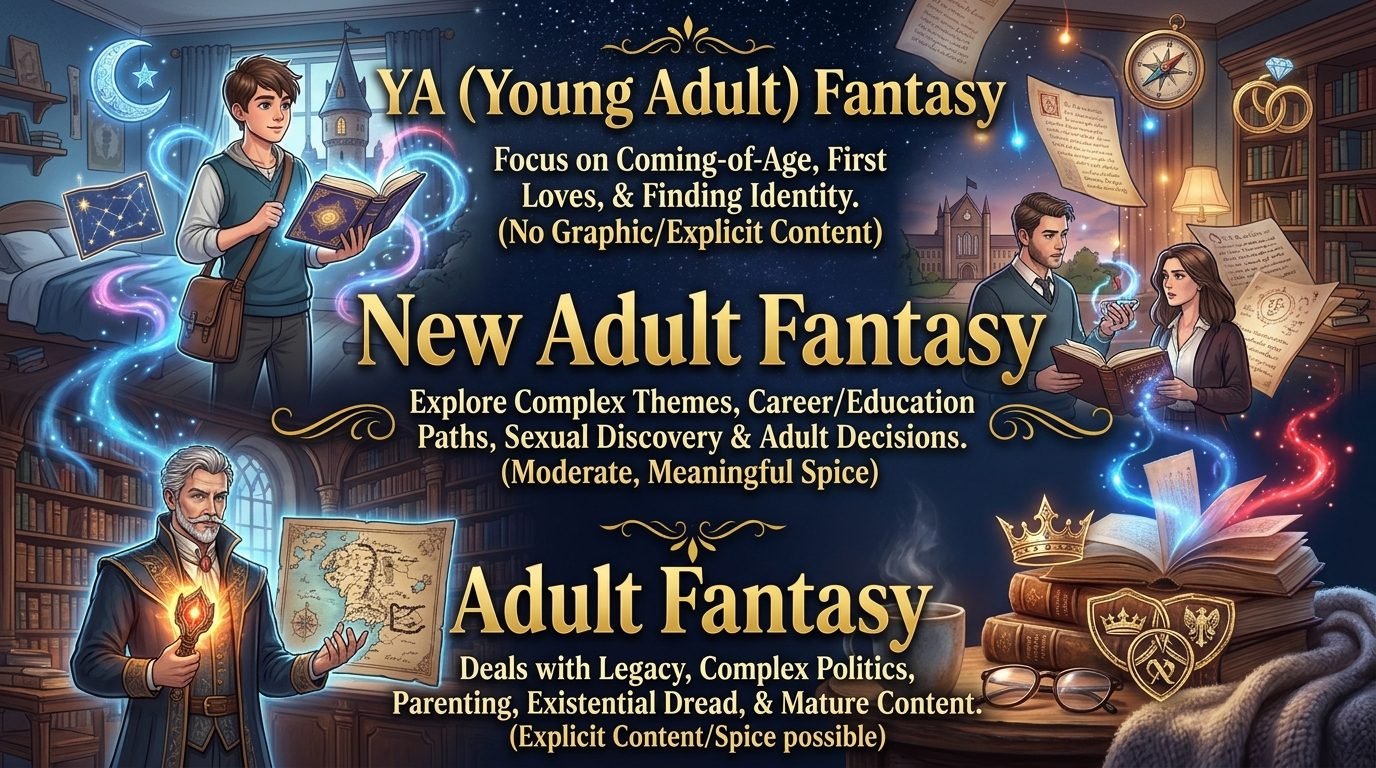
The short answer about YA vs. New Adult vs. Adult Fantasy : all three are audience and marketing categories applied to fantasy, and the real difference is who a book is written and sold for, not what magic system it uses. Young Adult (YA) fantasy is aimed mainly at teen readers. New Adult (NA) targets readers moving into their late teens and twenties. Adult fantasy is the broad, open-ended market for grown-up readers.
Protagonist age is a useful clue in the young adult vs new adult fantasy debate, but it is only one clue. Themes, life stage, tone and the way a publisher positions the book matter just as much, which is why you will find teenage heroes in adult epics and twenty-something heroes on the YA shelf. This guide breaks down each category, compares them side by side, and helps you decide where to start.
One framing point first. Fantasy is a genre: it tells you what a story contains (magic, invented worlds, mythic creatures). YA, NA and adult are categories that tell you who the book is aimed at. A single fantasy novel can sit in any of the three, and the lines are not applied consistently across publishers or countries.
What Is Young Adult Fantasy?
YA fantasy is written with teen readers in mind. Publishing sources generally describe the YA audience as roughly 12 to 18, with protagonists usually between about 13 and 19 . Plenty of adults read it too, but the teen reader is the target.
Common themes: identity, belonging, first love, friendship, independence from family, and finding your place in a bigger world. Many YA stories are about “firsts”: the first time you are really on your own, the first serious betrayal, the first real responsibility.
Common settings and challenges: academies, small towns hiding secrets, rebellions, quests, and heists. The protagonist often still answers to parents, teachers, mentors or rulers, even when they push against them.
YA is not automatically gentle. It regularly handles war, abuse, grief, mental health and morally grey choices. What tends to differ is the perspective and handling: YA often focuses on how a young person processes events and what they mean for who they are becoming.
Examples:
- Six of Crows by Leigh Bardugo (Henry Holt, 2015) is catalogued as young adult fiction and is shelved in teen sections by many libraries. It is a crew-driven heist with dark backstories, which shows that YA can be grim without being “adult.”
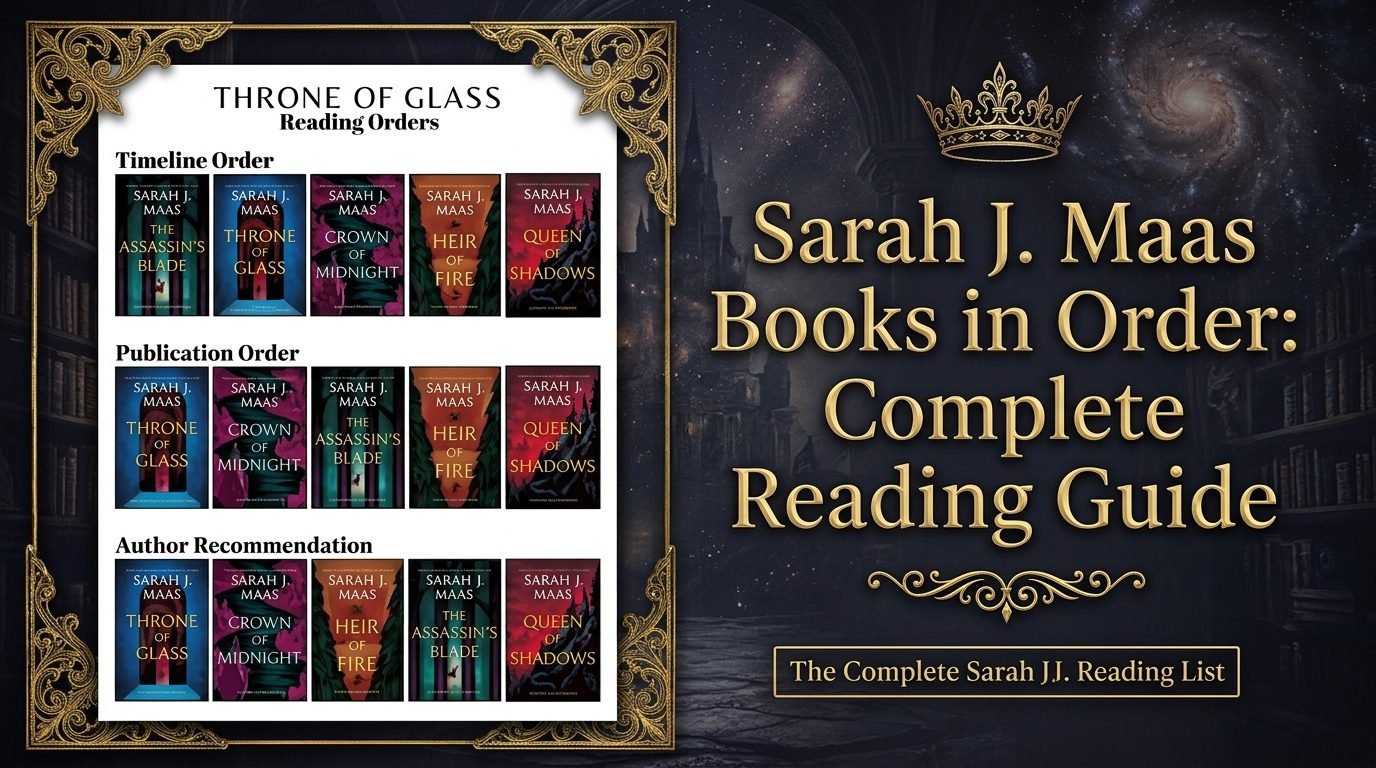
- Throne of Glass by Sarah J. Maas (Bloomsbury) launched Maas’s career as a YA author. It follows a young assassin competing for a royal post. (Needs human check on current edition labelling.)
What Is New Adult Fantasy?
New Adult is the youngest of the three labels and the least settled. It generally describes stories about people moving out of adolescence into independence, typically aimed at readers of about 18 to 25, though that range is informal.
What NA stories tend to explore: leaving home or school, college or an equivalent such as a war academy or apprenticeship, early careers, adult relationships, and making decisions without a safety net. The heroine or hero is often already part of the world and learning to hold their own in it, rather than just discovering that the world exists.
NA and romance. NA grew out of the self-publishing boom and became strongly associated with romance and more explicit content . But explicit sex is not a requirement of NA. An author writing in the category has pointed out the same . A New Adult fantasy can be mostly about ambition, friendship, survival or politics.
Official label vs. reader label. Very few fantasy books are formally marketed as New Adult, so be careful with the term:
- Fourth Wing by Rebecca Yarros (Red Tower Books, 2023) is the clearest verified case. Entangled launched Red Tower as “a New Adult commercial-fiction imprint focused on romantic fantasy and science fiction” and Fourth Wing was its first release, set at a brutal war college for dragon riders. Other trade coverage describes the imprint as adult, which shows how the labels overlap.
- A Court of Thorns and Roses by Sarah J. Maas is a good example of the informal label. It was published in 2015 by Bloomsbury’s children’s division, was framed by its author as New Adult in some accounts, and now appears under YA, NA or adult depending on the library, retailer and metadata library catalogues vary). Treat it as disputed rather than “an NA book.”
What Is Adult Fantasy?
Adult fantasy is fantasy published and positioned for grown-up readers. Within that label there is enormous variety: sprawling political epics, intimate character studies, grimdark war stories, cozy fantasy, mythic retellings and romantasy.
What “adult” actually signals: the intended audience and the way the book is sold, not a fixed level of darkness or sex. Some adult fantasy is extremely graphic. Some is gentle, funny or slow-paced.
Protagonist age is wide open. Adult fantasy has teen and even child protagonists, and an adult-market book can follow a character from adolescence into middle age. Writers and readers on genre forums often make this point: a teen lead does not automatically make a book YA.
Examples:
- The Poppy War by R.F. Kuang (Harper Voyager, 2018) is published by an adult imprint. Its protagonist, Rin, is a teenage war orphan at the start, and the book depicts war and its trauma without softening it. It is a strong example of why age alone does not decide category.
- The Queen of the Tearling by Erika Johansen (HarperCollins, 2014) follows a young queen learning to wield power amid political intrigue. School Library Journal described it as likely to appeal to fans of both adult and YA fantasy. (Needs human check on its official audience label.)
YA vs. New Adult vs. Adult Fantasy: Key Differences
Here is a quick young adult vs new adult fantasy comparison, with adult fantasy added. Read every row as a tendency, not a rule.
| Feature | YA Fantasy | New Adult Fantasy | Adult Fantasy |
|---|---|---|---|
| Typical protagonist age | About 13 to 19 | About 18 to 25 (sometimes older) | Any age |
| Intended readership | Mainly teens; many adult fans | Older teens and twenty-somethings; many adult fans | Adults |
| Life stage | School, home, first independence | Leaving home, college or training, early career | From young adulthood to elder age |
| Common themes | Identity, belonging, first love, finding your place | Self-reliance, building an adult identity, adult relationships | Politics, power, morality, war, family, loss, anything |
| Independence and agency | Often limited by guardians, mentors or institutions | Greater autonomy and consequences | Varies widely |
| Romance focus | Common, often central, typically less explicit on the page | Common and often central | Optional, from none to central (as in romantasy) |
| Sexual content | Usually limited on the page, but not always | Ranges from none to explicit | Ranges from none to explicit |
| Common settings | Academies, small towns, quests, rebellions | War colleges, courts, early-career or survival settings | Any setting, often larger in scope |
| Publishing positioning | Teen and children’s imprints, teen shelves | Imprints or marketing that name NA; often shelved as adult or YA | Adult imprints and shelves |
What this means in practice: no single row decides the category. Publishers weigh the intended audience, the voice and handling of the material, comparable titles and sales strategy alongside the protagonist’s age.
What Is the New Adult Age Range?
New Adult is most commonly associated with protagonists around 18 to 25 and with readers of roughly the same age. Definitions vary. Some sources place the readership at 18 to 25, others describe it as 20 and up, and some say characters can be nearer 30. One reader glossary notes that 23 to 24 is often where bookstores start shelving books as adult.
Two separate ideas get mixed up here:
- Protagonist age tells you where the character is in life.
- Intended readership tells you who the publisher expects to buy the book.
A nineteen-year-old hero could appear in a YA novel written for teens or in a New Adult novel written for older readers, and the difference would come down to voice, themes and marketing.
NA is also a category with limited infrastructure. School Library Journal reported that it received its own BISAC code (a romance sub-category) in 2013 , yet industry commentary says retailers rarely give it a dedicated section, so NA books are often filed as YA or adult.
Is New Adult Fantasy the Same as Romantasy?
No, though they overlap a lot.
- New Adult describes an audience and life stage: stories about people entering adulthood.
- Romantasy describes a blend of genres: fantasy and romance with a central love story, usually with a happy or hopeful ending.
Fourth Wing is both, but each label stands alone. A romantasy can have a thirty-five-year-old heroine, which would make it adult. A New Adult fantasy can be about rivalry, politics and survival with little or no romance.
If you are searching specifically for love-driven fantasy, use “romantasy” or “fantasy romance.” If you want stories about early adulthood, use “New Adult.” Using both together narrows the field.
Can a Fantasy Book Be Both YA and New Adult?
In practice, yes, or at least it can be treated as either depending on who is describing it.
Why overlap happens:
- Older YA and younger NA share many themes: identity, independence, love, the transition to adulthood.
- Publishers sometimes place a book in the category that gives it the best commercial shot.
- Retailers and libraries classify by their own rules, so the same title can be shelved differently.
- Some stories are marketed as “crossover” to appeal across audiences.
A Court of Thorns and Roses is the textbook case. Reader discussions show people disagreeing about whether the first book reads as YA and the sequels as NA, and library catalogues file the same title under teen and adult. Neither label is wrong, because the book sits where several categories meet.
The lesson: don’t rely on age or spice level alone. If a classification matters to you, for example when choosing a book for a teen, check the publisher’s own description, age guidance and content notes rather than a single label.
Which Fantasy Category Should You Read?
These are starting points, not rules.
- Pick YA fantasy if you like coming-of-age journeys, identity, found families and teen-centred stakes. Many adults read YA for exactly these reasons.
- Pick New Adult fantasy if you want stories about early adulthood, rising independence and building a life, often with a strong romantic thread.
- Pick adult fantasy if you want the widest range: from quiet character-driven stories to large political epics, in every tone and heat level.
You can mix and match. Plenty of readers move between all three depending on mood, and the best way to choose is to read the publisher’s description and a couple of reviews.
Frequently Asked Questions
What is the difference between YA and New Adult fantasy?
YA fantasy is aimed mainly at teens and tends to explore firsts and identity. New Adult fantasy is aimed at older readers and tends to explore independence and adult responsibility. They overlap, and the label depends partly on marketing.
What age range is New Adult?
Usually around 18 to 25, for both protagonists and readers, though sources differ.
Is New Adult considered adult fiction?
It sits between YA and adult. It is written for adult readers, but many retailers file it as adult or YA because NA has no firm shelf of its own.
Is New Adult fantasy more explicit than YA fantasy?
Often, but not always. NA can include explicit content, yet it is not required, and some YA handles mature subjects seriously. Check content notes.
Is YA fantasy only for teenagers?
No. Teens are the intended audience, but adults make up a large share of readers.
Can a book have YA themes but be marketed to adults?
Yes. Adult-market fantasy often has young protagonists and coming-of-age arcs. The Poppy War starts with a teenage lead but is published for adults.

Hi, I’m Nisbah – a blogger with over 2 years of experience creating content and a fantasy enthusiast who loves exploring magical worlds, fantasy books, captivating stories, and unforgettable characters. I share book recommendations, reviews, fantasy insights, and story discussions and creating guides to help readers discover their next great adventure.