
In fantasy worlds, magic isn’t just a sparkle or visual effect it’s an entire system. But have you ever wondered why the magic in Harry Potter feels so different from the magic in The Lord of the Rings? That all comes down to soft vs. hard magic systems.Have you ever noticed how some fantasy worlds make magic feel mysterious and unexplained while others lay out exact rules for how it works? That difference isn’t accidental. It comes down to one of the most important concepts in fantasy writing: soft vs hard magic systems.
Whether you’re a reader trying to understand your favourite books, or a writer building your own world, this guide breaks down everything you need to know.
What Is a Magic System?
A magic system is the set of rules (or lack thereof) that governs how magic works in a fantasy world. It answers questions like:
- Where does magic come from?
- Who can use it?
- What are its limits?
- What does it cost?
Every fantasy story with magic has a system even if that system is “magic is unpredictable and mysterious.” The question is just how defined that system is. That’s where the soft vs hard spectrum comes in “From elemental to necromancy, each type fits differently into hard or soft systems [ explore all 15 types of magic in fantasy. ]”
What Is a Hard Magic System?
A hard magic system is one where the rules are clearly defined, consistent, and understandable both for the characters and the reader.
Think of it like a video game. You know exactly what moves are available, what each spell costs, and what the consequences are. Nothing comes out of nowhere.
Key Features of Hard Magic:
- Clear rules: the magic follows specific, knowable laws
- Defined costs: using magic has a price (energy, health, metal, etc.)
- Logical limits: there are things magic simply cannot do
- Learnable: characters (and readers) can study and master it
Hard Magic System Examples:
Mistborn by Brandon Sanderson The most famous example. Characters called Allomancers can “burn” specific metals to gain specific powers. Burn iron = pull on metals. Burn steel = push on metals. Every ability has a rule. Every rule has an exception that’s also ruled. There are zero surprises that weren’t foreshadowed.
Avatar: The Last Airbender Each bending style is tied to a specific element and a specific martial arts tradition. Firebenders can’t suddenly bend water. The rules are crystal clear which is why subversions like lightningbending feel earned, not random.
Fullmetal Alchemist “Equivalent exchange” to gain something, you must sacrifice something of equal value. This single rule drives the entire story and every conflict within it.
What Is a Soft Magic System?
A soft magic system is one where the rules are vague, mysterious, or largely unexplained. Magic feels like a force rather than a tool. It’s wonder-inducing precisely because you don’t fully understand it. “Soft magic especially suits villains their power feels more terrifying when unexplained. Read about the villain arc and how magic shapes character transformation.”
Key Features of Soft Magic:
- Mysterious source: where it comes from is unclear or divine
- Unpredictable: characters (and readers) can’t always anticipate what it can do
- No clear cost: or the cost is vague (“it takes great sacrifice”)
- Awe-inspiring: the mystery is the point
Soft Magic System Examples:
The Lord of the Rings by J.R.R. Tolkien Gandalf’s magic is never really explained. He can do things when the story needs him to. Why couldn’t he just magic the Ring into Mount Doom? Because soft magic doesn’t work on demand it works when the narrative requires it. And that’s fine, because Tolkien never promised you a rulebook. In LOTR, fantasy races like Elves and Wizards wield soft magic it feels ancient and divine, never fully explained.”
Harry Potter by J.K. Rowling This one surprises people, but Harry Potter leans soft. Yes, there are named spells but there are no clear rules for why some magic works and other magic doesn’t. Why can’t they just Accio Horcruxes? Why does love defeat Voldemort? Because magic in this world is more emotional than logical.
The Chronicles of Narnia Aslan’s magic is divine and unexplained. It operates on “deeper magic” that the characters (and readers) can only partially understand. That’s the point.
Soft vs Hard Magic: A Side-by-Side Comparison
| Feature | Hard Magic | Soft Magic |
|---|---|---|
| Rules | Clearly defined | Vague or absent |
| Cost | Specific and consistent | Undefined or emotional |
| Predictability | High | Low |
| Reader experience | Intellectual satisfaction | Wonder and awe |
| Best for | Problem-solving plots | Epic/mythological tales |
| Famous example | Mistborn, FMA | LOTR, Narnia |
| Subverted expectations? | Feels earned | Feels magical |
Soft magic is deeply tied to prophecy and fate vs destiny in fantasy storytelling the hero’s power often can’t be fully understood, only felt.”
Brandon Sanderson’s Laws of Magic
No discussion of hard vs soft magic is complete without Brandon Sanderson’s Three Laws of Magic the most cited framework in fantasy writing.”These quotes reflect Tolkien’s mysterious worldview learn why in our breakdown of LOTR’s soft magic system explained.”
First Law:
An author’s ability to solve conflict with magic is directly proportional to how well the reader understands that magic.
In other words: if you want your hero to win using magic, the reader needs to understand exactly how and why it works. Soft magic can’t resolve climaxes it can only create wonder.
Second Law:
Limitations are more interesting than powers.
What magic can’t do is more interesting than what it can. A character who can move mountains but can’t heal a single wound is far more compelling than one who can do everything.
Third Law:
Before adding something new, expand on what you have.
Don’t keep introducing new powers. Go deeper into the magic you already have. The best fantasy worlds feel complete, not infinite.
Is One Better Than the Other?
No. They serve different purposes.
Choose hard magic if:
- Your story involves characters solving problems with magic
- You want readers to follow along with strategy and logic
- Your themes involve mastery, discipline, or consequence
Choose soft magic if:
- Your story is about myth, legend, or destiny
- Magic should feel divine, ancient, or beyond human understanding
- Your themes involve faith, wonder, or forces beyond control
Many great fantasy series actually use both a hard system for the protagonist and a soft system for the antagonist or divine forces. This creates a satisfying contrast: the hero works hard within rules, while the villain or gods operate beyond them.
The Magic Spectrum: It’s Not Just Soft or Hard
Most magic systems actually sit somewhere in the middle. Some authors call this the magic spectrum:
- Full Soft → LOTR, Narnia
- Soft-Leaning → Harry Potter, Wheel of Time (early books)
- Middle → The Witcher, Name of the Wind
- Hard-Leaning → Stormlight Archive, Wheel of Time (later books)
- Full Hard → Mistborn, Fullmetal Alchemist
Where a magic system sits on this spectrum shapes your entire reading experience the suspense, the climaxes, the character arcs.
Wheel of Time (Robert Jordan) Hard-Leaning
One of the most detailed magic systems ever written. Channelers draw on the One Power, split into male half saidin and female half saidar, weaving them into specific spells using five elements: fire, water, earth, air, and spirit. The rules are strict men and women access different halves, strength determines how much power you can channel, and pushing beyond your limits burns your connection permanently.
If LOTR’s mysterious soft magic is what draws you in, check out these books similar to Lord of the Rings that capture the same wonder.”
On the surface, this reads like textbook hard magic. But underneath sits a soft layer: a mysterious cosmic Wheel weaving fate around the heroes, a dream world only some can enter, and ancient forces of Light and Dark that remain unexplained even by the final book. Hard rules for the characters, soft forces for the universe and that contrast is exactly what makes the series feel both grounded and epic.
Fullmetal Alchemist (Hiromu Arakawa) Hard with a Soft Core
Equivalent Exchange is one of the cleanest magic rules ever written: to create something, you must sacrifice something of equal value. Every transmutation follows three steps comprehension, deconstruction, reconstruction and State Alchemists carry personal circles for quick-cast spells tied to their specialty.
The system feels almost mathematical. Yet the deeper you go, the softer it gets: the Gate of Truth, the mysterious source of all alchemic power, and the entity simply called God remain unexplained throughout. Arakawa was smart enough to keep the human magic hard and the divine magic soft so the rules feel satisfying while the mystery feels earned.
Avatar: The Last Airbender Hard
Bending is one of the most elegantly hard systems in any medium. Each bender controls exactly one element no exceptions outside the Avatar and every technique within that element follows an internal logic. Waterbenders discovering healing, Earthbenders unlocking metalbending, Firebenders learning to redirect lightning none of these feel like rule-breaking because they all flow naturally from what the element is.
The spirit world adds a softer layer, but it never bleeds into the main bending system. This is why the show works so well for younger audiences and seasoned fantasy readers alike: you always know exactly what’s possible, and the creativity comes from how characters use those known rules, not from inventing new ones.
The Broken Earth Trilogy (N.K. Jemisin) Soft-Leaning
Orogenes manipulate kinetic and thermal energy to move the earth dangerous, visceral, and deeply political. The hard rule is simple: use it carelessly and you’ll ice everyone around you, draining their heat. But almost everything else is soft. The mysterious obelisks, the souls bound into the magic system, the ancient entity that is essentially the Earth itself none of it is fully explained, even at the end.
Jemisin uses this softness deliberately: the unexplained mysteries mirror the unexplained oppression her characters face. When the source of power is unknowable, the people who wield it become easy to fear and control. The magic system is the theme.
Old Kingdom Series (Garth Nix) Middle Ground
Nix splits his magic into a clean binary Charter magic (structured, runic, learnable) and Free magic (raw, corrupting, dangerous) and that split itself tells you everything about the world’s moral landscape. Charter mages follow rules; Free magic users follow hunger.
The Abhorsen’s bells are a masterclass in hard magic design: each bell compels the dead to do one specific thing, no more. Yet death itself is a soft river that spirits travel down toward whatever comes next mysterious, navigable, and never fully mapped. This middle-ground balance is why the series has aged so well. The rules give you safety; the mystery gives you dread.
Final Thoughts
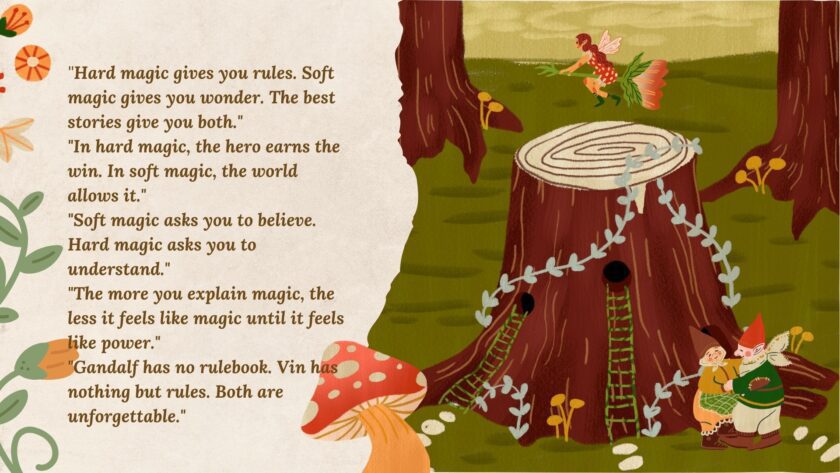
The soft vs hard magic divide is one of the most fascinating lenses through which to read fantasy. Once you understand it, you’ll never read a magic system the same way again you’ll start noticing why certain moments feel earned and others feel like cheating.
Both systems can produce brilliant stories. The key is knowing which one your story needs and then committing to it fully.
Want to go deeper? Read our Complete Guide to Magic Systems in Fantasy we break down 15 types of magic, the best examples from books and films, and how to build your own.
FAQ: Soft vs Hard Magic Systems
1. What is the difference between soft and hard magic systems?
A hard magic system has clear rules, limits, and explanations. A soft magic system is mysterious and less defined, focusing more on wonder than logic.
2. What are some hard magic system examples?
Popular hard magic systems include:
- Mistborn
- Avatar: The Last Airbender
- Fullmetal Alchemist
These systems have strict rules and consistent abilities.
3. What are some soft magic system examples?
Common soft magic systems include:
- The Lord of the Rings
- The Chronicles of Narnia
- Game of Thrones
Magic is often mysterious and unpredictable.
4. Is Harry Potter a hard magic system?
Harry Potter uses a mix of both, but it leans more toward a soft magic system because many magical abilities and limits are never fully explained.
5. What are the best hard magic systems in fantasy?
Fans often consider these among the best:
- Mistborn
- Avatar: The Last Airbender
- The Stormlight Archive
- Fullmetal Alchemist
They are praised for consistency and creative rules.
6. What is a soft vs. hard power system?
A power system is similar to a magic system. Hard power systems follow clear mechanics and rules, while soft power systems stay flexible and mysterious.
7. How do you create a hard magic system?
To create a hard magic system:
- Define clear rules
- Add limitations and costs
- Keep abilities consistent
- Explain how powers work
- Avoid random solutions without setup
Consistency is the key to making it believable.
8. Why do people discuss soft vs. hard magic systems on Reddit?
Fantasy fans on Reddit often debate which style is better because hard magic creates strategic storytelling, while soft magic adds mystery and wonder.
Stay Connected and Share Your Feedback
Our site is dedicated to helping individuals and organizations unlock real potential through capability intelligence, adaptive evaluation models, and learning transformation, with fantasy guides books, magical recipes . We share insights, research-backed strategies, and practical guidance to support human-centered growth and future-ready workforce alignment at Ravens Diary.
- Get Digital Product Bundles On Ravens Diary. Shop
If you find our content valuable, we’d love your feedback, and you can get notified of new posts by bookmarking this page. Whether you’re a professional, educator, or leader, our goal is to provide trust

Hi, I’m Nisbah – a blogger with over 2 years of experience creating content and a fantasy enthusiast who loves exploring magical worlds, fantasy books, captivating stories, and unforgettable characters. I share book recommendations, reviews, fantasy insights, and story discussions and creating guides to help readers discover their next great adventure.