

About this guide: This article draws on the canonical texts of the Hebrew Bible and New Testament, the angelological writings of Pseudo-Dionysius the Areopagite, Thomas Aquinas's Summa Theologica, and contemporary scholarly works including Michael Heiser's The Unseen Realm (Lexham Press, 2015). Reviewed and updated May 2026.Introduction
Most people picture an angel as something gentle. Wings, light, a reassuring expression. The beings stationed closest to God’s throne are nothing like that. They are vast, fire-wreathed, and covered in eyes. Once you actually read what Ezekiel saw, the soft-focus image of angels never quite recovers.
Throne angels sit at the top of the celestial hierarchy and yet most articles about them barely scratch the surface. This guide doesn’t do that. You’ll find their scriptural origins, exact role in the angelic order, what different religious traditions say, how they compare to seraphim, what it means spiritually to encounter one, and much more.
What Is a Throne Angel? Definition and Celestial Role
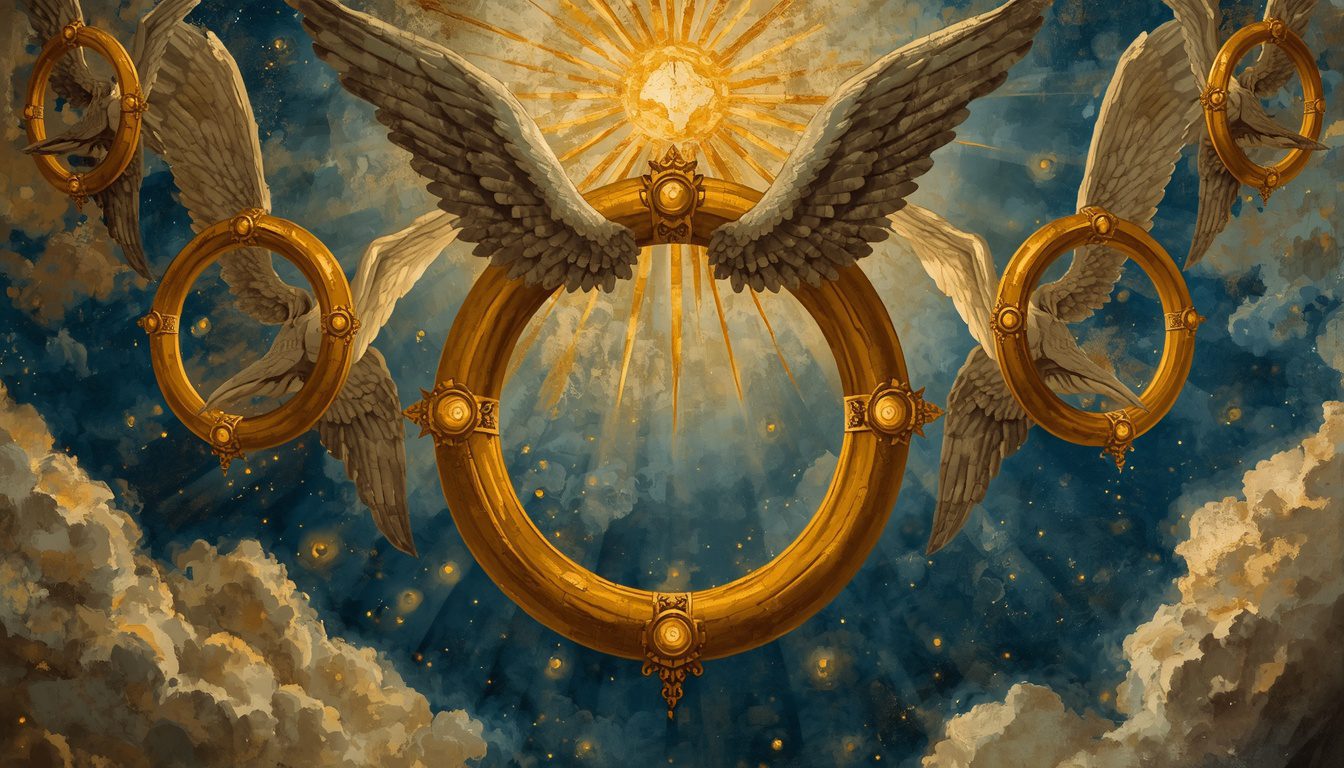
A throne angel, called a “Throne” in formal theology, belongs to the highest tier of angelic beings described in Scripture. The word traces back to the Greek thronos, meaning seat or throne. These angels are understood to be the divine chariot of God not as a figure of speech but as a theological reality within the Hebrew and Christian cosmological frameworks.
The Apostle Paul named them explicitly in Colossians 1:16, listing “thrones” alongside dominions, rulers, and powers as created heavenly beings. That single verse generated centuries of debate about what each order actually does. The most widely accepted framework, drawn from Pseudo-Dionysius the Areopagite’s 5th-century Celestial Hierarchy, places Thrones in the first sphere of angels the category nearest to God, above all other orders. Their function is not to deliver messages. It is to embody and transmit divine authority itself.
The Ophanim Connection Same Beings, Different Names?
In Hebrew tradition, the wheel-creatures in Ezekiel’s vision are called Ophanim (אוֹפַנִּים) simply “wheels.” Many theologians argue the Ophanim and the Thrones are the same beings seen through two different cultural lenses. Others treat them as distinct. The biblical text doesn’t close the argument cleanly. What both traditions agree on: these beings are permanently near God and form the structural foundation of his authority.
Origins of Throne Angels in Scripture and Tradition
The concept of angelic ranks grew from specific biblical visions Ezekiel and Daniel combined with apocryphal sources and early Christian commentary. The Book of Daniel (7:9) describes the Ancient of Days seated on a fiery throne with wheels of burning fire. That imagery maps almost exactly onto what Ezekiel recorded roughly a century earlier, “throne angels one of the most misunderstood orders”.
Paul’s letter to the Colossians (60 CE) was the first apostolic attempt to classify heavenly thrones as a specific order of created beings. Origen, Irenaeus, and Pseudo-Dionysius formalized the hierarchy from there. By the time Thomas Aquinas systematized it in the 13th century, the nine-order structure had become mainstream Catholic theology and it still shapes how most Christians think about angelic ranks today.
Ezekiel Chapter 1: The Vision That Anchors Everything
Ezekiel 1 is blunt and disorienting. Ezekiel sees four living creatures with four faces each human, lion, ox, eagle and four wings. Beside them are massive wheels, beryl-colored and full of eyes around their rims, that move in perfect coordination with the creatures without ever turning. Jewish scholars identify this entire system as the Merkabah the divine chariot. Merkabah mysticism, a major strand of early Jewish esotericism, treats this chapter as its foundational text. The JPS translation of Ezekiel 1 is freely available and worth reading directly. No summary captures it.
What Do Throne Angels Look Like? The Full Biblical Picture
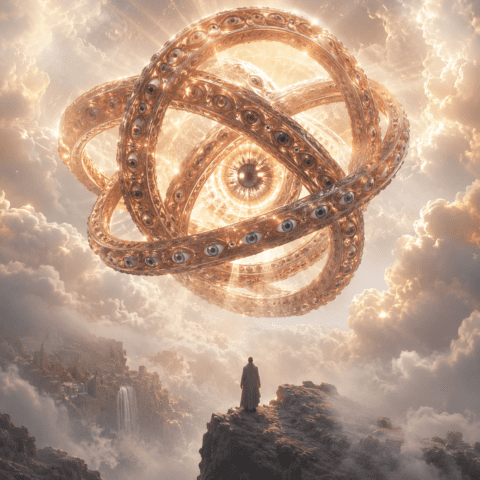
Throne angels appear as four-faced, fire-surrounded creatures moving alongside enormous eye-covered wheels nothing like the winged human figures most people imagine.
Biblical descriptions of throne angels share almost nothing with Renaissance painting. That matters because people regularly confuse artistic tradition with scriptural fact. In Ezekiel’s vision, the creatures had four different faces simultaneously human, lion, ox, eagle wings that touched each other, and feet like gleaming bronze. Fire moved among them constantly. The wheels, enormous and covered entirely in eyes, moved with them as one unified system.
The wheels full of eyes are the detail most people struggle with. Eyes throughout the Hebrew Bible represent complete awareness and judgment no blind spot, no hidden angle. Theologians from Irenaeus onward interpreted them as God’s omniscience made visible through these beings. The fire carries similar weight: divine holiness and consuming fire are inseparable throughout the Hebrew scriptures. Every visual detail here is doing theological work.
Why Are Throne Angels Covered in Eyes?
In ancient Near Eastern cosmology, the eye was the organ of divine knowledge and judgment. A being covered in eyes misses nothing. N.T. Wright and other contemporary theologians argue these visual details communicate the character of divine governance God’s authority, as embodied in these beings, is total and all-seeing. The strangeness is intentional. It’s the point.
What Do Throne Angels Do? Powers, Purpose, and Cosmic Function
Throne angels are not messengers. That role belongs to the lower orders. Their function across every relevant text is to sustain and execute divine justice at a cosmic level not as administrators but as the structural foundation through which God’s authority operates in the created order.
In Christian angelology, they receive divine illumination directly and transmit it downward without distortion. Pseudo-Dionysius is unusually precise about this: they don’t simply pass information along but embody divine authority as they transmit it. These beings aren’t powerful in a generic sense. They carry one specific kind of power the structural authority that holds the entire angelic order together.
The Angelic Hierarchy | Where Do Throne Angels Fit?
The nine-order system synthesizes several scriptural passages Colossians 1:16, Ephesians 1:21, Isaiah 6, Ezekiel 1 into a coherent framework. The first sphere holds the orders closest to God. The third sphere holds the orders that interact most directly with humanity. Throne angels sit in the first sphere alongside Seraphim and Cherubim.
| Sphere | Angelic Orders | Primary Function |
|---|---|---|
| First (nearest to God) | Seraphim, Cherubim, Thrones | Direct divine contemplation; transmit and embody God’s authority |
| Second | Dominions, Virtues, Powers | Govern cosmic forces; regulate the natural order |
| Third | Principalities, Archangels, Angels | Oversee nations; interact directly with humanity |
This structure matters practically. When people ask why throne angels don’t speak to humans in Scripture, this hierarchy gives the answer. Direct human interaction belongs to the third sphere. The first sphere operates at a level Scripture doesn’t describe as accessible to ordinary human experience.
Throne Angels vs Seraphim | What Is Actually Different?
This comparison comes up constantly and most sources handle it carelessly. People assume Seraphim rank higher because Isaiah’s vision of them is more famous. That’s not accurate. Both orders belong to the first sphere. The real difference is functional, not hierarchical, much like the debate around throne angels in scripture.
| Feature | Throne Angels | Seraphim |
|---|---|---|
| Primary biblical text | Ezekiel 1, Colossians 1:16 | Isaiah 6:1–7 |
| Appearance | Wheels, eyes, fire, four-faced | Six wings, humanoid, burning |
| Core function | Sustain and transmit divine authority | Continuous worship; purification |
| Symbolism | Justice, omniscience, cosmic order | Holiness, praise, purification |
| Human interaction | None recorded in canonical texts | Direct (Isaiah’s lips purified in Isaiah 6) |
Seraphim cry “Holy, holy, holy” in Isaiah’s temple vision. Their orientation is worship and purification. Throne angels are oriented toward governance and structural authority. Both are equally near God but pointed in different directions. Think of it this way: if Seraphim are the choir, throne angels are the architecture of the building itself.
Throne Angels Across Three Religious Traditions
Most articles treat throne angels as an exclusively Christian concept. They are not. Three distinct traditions have their own version and the overlap is striking.
- In Judaism, the Merkabah tradition built an entire mystical system around Ezekiel’s vision. The Heikhalot literature (3rd–7th century CE) describes the divine throne and its attendant beings in extraordinary detail predating much of formal Christian angelology.
- In Islam, the Hamalat al-‘Arsh (حَمَلَةُ الْعَرْشِ) appear in Surah Ghafir (40:7) as bearers of God’s throne who intercede for believers. Islamic tradition holds that four currently carry the throne and eight will bear it on the Day of Judgment. In Kabbalistic mysticism, the Arelim serve an analogous role within the Sephirotic structure, linked to the divine throne and cosmic justice.
The consistency across traditions that developed largely independently is hard to dismiss, “the structured angelic hierarchy including throne angels“. A class of divine beings sustaining God’s authoritative presence that idea appears in all three theologies with enough structural overlap to suggest a shared ancient Near Eastern root.
Can Throne Angels Communicate With Humans?
The scriptural answer is clear ”NO”: there is no recorded case of a throne angel speaking directly to a human in canonical texts. Every angelic communication involves the lower orders messengers, archangels. The first sphere operates at a level that, in Scripture, produces awe and prostration rather than conversation.
See Also: Villain Arc Meaning Explained: Why They Feel So Real
In 2025 and 2026, interest in spiritual discernment and angelic encounters has grown well beyond traditional religious circles. My honest view: if someone reports an experience involving beings like those in Ezekiel 1, careful discernment is the right response not instant acceptance or dismissal. Test the experience against Scripture, seek counsel from a trusted spiritual director, and resist building an entire theological framework around a single moment. That’s not skepticism. It’s exactly what the tradition recommends.
Signs a Throne Angel May Be Near
Nobody will hand you a checklist for this and anyone who claims to have one should be approached with caution. That said, people across centuries have described remarkably consistent experiences: an overwhelming, sourceless sense of peace, light that feels warm and directional rather than physical, and a stillness that feels like something settling rather than just silence.
Recurring symbols matter too. Wheels, fire, or eyes appearing across unconnected dreams have been documented in mystical literature as precursors to spiritual awakening. The Heikhalot texts describe preparatory experiences near the divine throne trembling, heat, a feeling of being completely known. Whatever you make of it theologically, the pattern is consistent. The tradition’s advice is simple: sit with it, pray, and talk to someone wise before drawing conclusions.
What Does Seeing a Throne Angel Mean Spiritually?
This question keeps coming up and it deserves a serious answer rather than vague reassurance. In Scripture, every recorded encounter with high-order divine beings produces the same immediate response: the person collapses. Ezekiel fell on his face. Isaiah cried out that he was undone. Daniel was left without strength. These aren’t minor reactions. They are the natural human response to encountering something genuinely beyond ordinary experience.
Theologically, such a vision is understood as a call toward transformation, not information. It isn’t a reward for spiritual maturity. It is more like a commission a reorientation of a person’s entire direction. Contemporary spiritual directors working in the Christian tradition consistently advise the same response: write it down in detail immediately, do not share it widely, test it against Scripture, and bring it to a trusted guide. The experience itself is not the point. What you do with it afterward is.
Throne Angel Tattoos | Spiritual Meaning and Symbolism
Throne angel tattoo imagery has grown noticeably in 2025 and 2026 particularly the Ophanim wheel design, which is visually unlike anything else in religious iconography. A beryl-colored wheel covered in eyes, surrounded by fire. As a tattoo, it carries weight precisely because it doesn’t look decorative. People who choose it tend to know exactly what it represents.
The symbolism layers meaningfully. The wheel represents divine omniscience the all-seeing authority of God. Fire signals purification and holiness. The interlocking wheel-within-a-wheel structure in Ezekiel has been interpreted as the inseparability of God’s justice and mercy. For most people drawn to this design, it connects to divine protection or a significant spiritual turning point. Worth knowing what it means before it’s permanent.
Are Throne Angels Real or Symbolic? A Straight Answer
Traditional Judaism, Christianity, and Islam all treat angels including the highest orders as literal theological reality. That doesn’t mean every visual detail in Ezekiel is photographic. Ancient apocalyptic literature used symbolic imagery to communicate theological truth. The wheels and eyes may be describing the character of divine governance in terms a human mind can partially grasp. The beings themselves are nonetheless understood as real across all three traditions.
Michael Heiser, whose The Unseen Realm (Lexham Press, 2015) remains widely assigned in seminary courses as of 2026, argues that reading these texts as pure metaphor misreads the biblical authors’ worldview entirely. Their cosmology included a populated heavenly realm as a given not a primitive belief awaiting correction. Taking that seriously is actually the more careful reading of the evidence.
Frequently Asked Questions About Throne Angels
1. What do throne angels do?
They sustain and transmit divine authority the structural foundation nearest to God, governing cosmic order and passing divine illumination downward to lower angelic orders.
2. Are throne angels the same as Ophanim?
Most scholars treat them as the same beings described through different cultural frameworks. The functional overlap between Ezekiel’s wheel-creatures and Paul’s “thrones” in Colossians is substantial enough that most angelology texts treat them as equivalent.
3. Do throne angels have wings?
The creatures in Ezekiel’s vision have four wings each but wings aren’t their defining feature. The wheels covered in eyes are. Traditional iconography often depicts them as fiery wheels rather than winged human figures.
4. How many throne angels are there?
Scripture gives no specific number. Some Jewish apocryphal texts assign numbers to the Ophanim but these are non-canonical. The theological consensus is simply: many, and unspecified.
5. What is the difference between throne angels and seraphim?
Seraphim are oriented toward worship and purification. Throne angels are oriented toward divine justice and cosmic authority. Both belong to the first sphere but serve distinct, non-overlapping functions.
6. What does seeing a throne angel mean spiritually?
Scriptural encounters with high-order divine beings consistently produced transformation, not comfort. Document it, test it against Scripture, and seek guidance from a trusted spiritual director.
7. What do throne angel tattoos represent?
The Ophanim wheel design fire, interlocking wheels, eyes symbolizes divine omniscience and God’s all-seeing authority. People drawn to it typically associate it with protection, spiritual awakening, or a personal turning point.
8. Are throne angels mentioned in the Bible?
Yes. Ezekiel 1, Colossians 1:16, and Daniel 7:9 all reference them. These are canonical texts, not apocryphal additions.
Stay Connected and Share Your Feedback
Our site is dedicated to helping individuals and organizations unlock real potential through capability intelligence, adaptive evaluation models, and learning transformation, with fantasy guides books, magical recipes . We share insights, research-backed strategies, and practical guidance to support human-centered growth and future-ready workforce alignment at Ravens Diary.
- Get Digital Product Bundles On Ravens Diary. Shop
If you find our content valuable, we’d love your feedback, and you can get notified of new posts by bookmarking this page. Whether you’re a professional, educator, or leader, our goal is to provide trusted resources that empower you to develop talent, make smarter decisions, and achieve measurable results.

Hi, I’m Nisbah – a blogger with over 2 years of experience creating content and a fantasy enthusiast who loves exploring magical worlds, fantasy books, captivating stories, and unforgettable characters. I share book recommendations, reviews, fantasy insights, and story discussions and creating guides to help readers discover their next great adventure.